

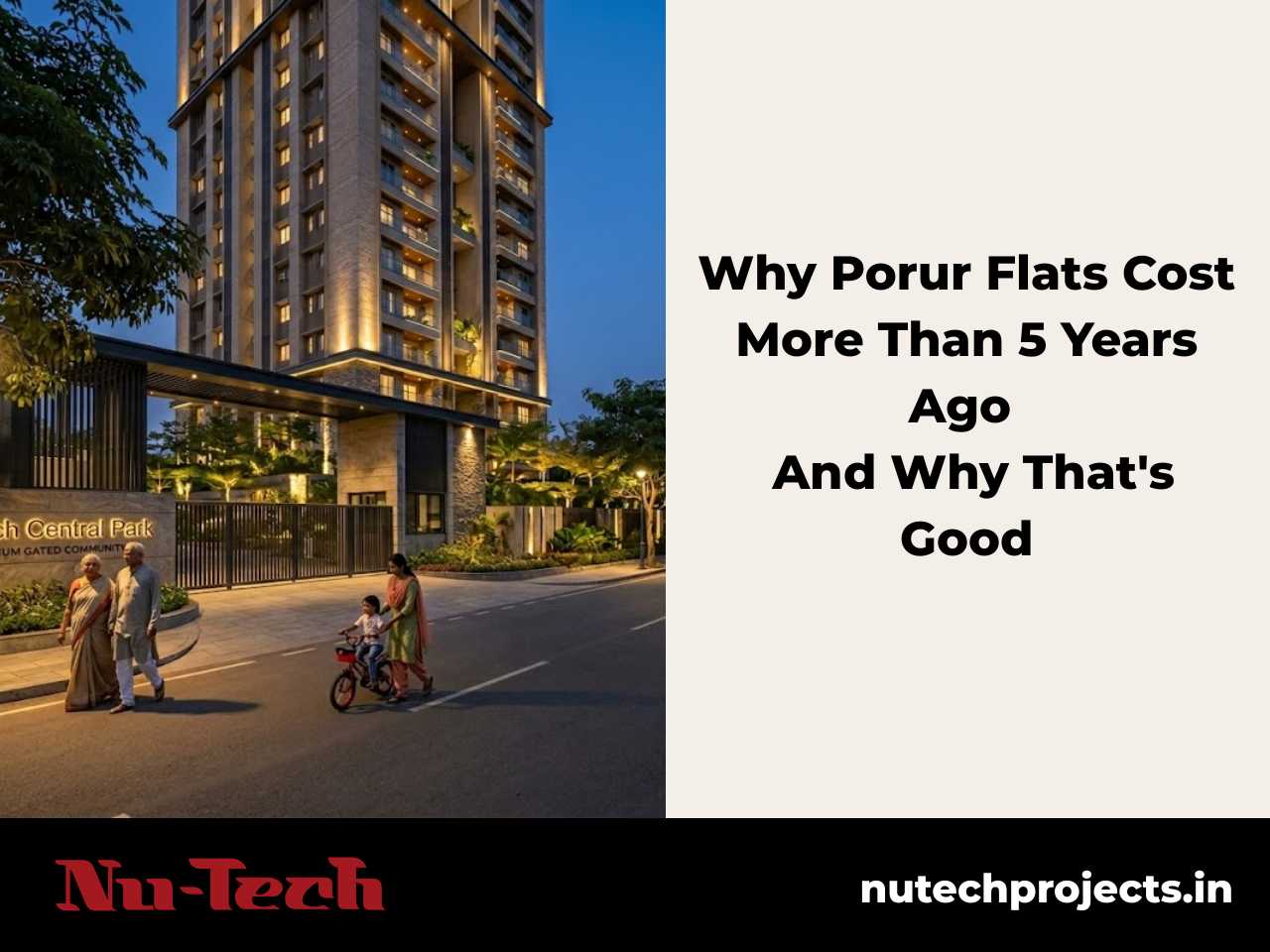
The 'West Chennai Premium': Why Porur Flats Cost More Than 5 Years Ago — And Why That's Good
Posted on :
You look at flats in Porur today and the price surprises you. It's higher than you expected. Your first instinct is to wonder if you've missed the window. You haven't. In fact, the reason prices have gone up is the same reason buying here still makes sense. Let's break it down simply.
Porur Wasn't Always This Sought After
Five years ago, Porur was an affordable option. Nothing more. People came here because they couldn't stretch the budget to Adyar or Anna Nagar. The location was decent, but nobody called it a premium address.
Today, that has changed. Here's what's different:
-
Buyers who purchased flats in Porur between 2019 and 2021 have seen their property values rise significantly
-
New projects coming up here are better quality than what was built five years ago
-
People who can afford to buy elsewhere are choosing Porur anyway
That last point is the real signal. When a neighbourhood stops being a compromise and becomes a choice, prices follow.
The Metro Made Commuting Predictable
Before the Vadapalani to Poonamallee metro line, getting in and out of Porur meant dealing with GST Road traffic. On a bad day, that's 90 minutes for a 15 km stretch.
The metro changed that equation completely:
-
IT professionals working in Guindy, Ekkattuthangal, or Vadapalani now have a reliable commute option
-
Travel time dropped for thousands of daily commuters
-
Porur went from "far from everything" to "well connected" almost overnight
When connectivity improves like this, property prices in that area go up. It has happened in every city where a metro line opened. Chennai was no different. The Vadapalani-Poonamallee Metro's impact on Porur living covers this in detail if you want the full picture.
Other Infrastructure Caught Up Too
The metro was the headline, but several other things improved around the same time:
-
The Porur junction flyover eased one of Chennai's worst bottlenecks
-
Road widening along Trunk Road and Poonamallee High Road reduced daily congestion
-
Access to Ramapuram, Perungalathur, and Manapakkam IT clusters became smoother
Individually, none of these feel dramatic. But put them together and you get a neighbourhood where getting around is genuinely easier than it was five years ago. That kind of improvement doesn't get priced into a flat overnight, but it does get priced in eventually. The piece on how infrastructure has been transforming Porur maps out how these changes stacked up over time.
The People Moving Here Are Different Now
Here's a simple way to understand why product quality has gone up in Porur. The buyer has changed.
Five years ago: buyer is stretching budget, choosing Porur because it's affordable, willing to compromise on amenities.
Today: buyer has options, choosing Porur because it makes sense, and expecting the same features they'd get in a premium project anywhere in Chennai.
Builders responded to that shift. New projects now offer:
-
Landscaped podiums and rooftop amenities
-
EV charging points
-
Smart home features
-
Better build quality and finishes
You're not just paying more for the same flat. You're paying more for a better one. For context on how these standards compare across Chennai, the discussion on what defines luxury housing in Chennai today is worth a read.
No Oversupply Mess to Worry About
Some parts of Chennai had too many flats launched between 2016 and 2019. Builders over-estimated demand. Projects sat unsold. Prices stagnated or fell. Buyers got nervous.
Porur avoided this. Launches here were measured and matched to actual demand. What this means for you practically:
-
No distressed inventory dragging down prices in the resale market
-
Builders here didn't panic-sell, so pricing stayed healthy
-
If you buy today, you're not competing against desperate resale listings when it's your turn to sell
This is why choosing a reputed builder matters. Builders who read the market correctly tend to build in the right places at the right time, and that protects your investment too.
Is It Still Worth Buying at Today's Price?
This is the question most buyers land on. Here's a straight answer.
Porur is more expensive than it was in 2020. But compared to similar quality flats in OMR, Perambur, or the central corridors, it is still more affordable. The infrastructure story here is also not finished. Commercial development along Poonamallee High Road is ongoing. More IT campuses are expanding nearby.
Before you decide, make sure your budget is realistic. Running through home loan EMI planning before you shortlist projects will save you a lot of back and forth later.
A Higher Price Tag Is a Good Sign, Not a Red Flag
When a neighbourhood keeps getting more expensive year after year, it means one simple thing: people keep wanting to live there.
That is exactly what has happened in Porur. The metro arrived. Roads improved. Better projects came up. More buyers followed. Prices went up because demand went up, and demand went up because the area genuinely got better.
The buyers who regret waiting aren't the ones who paid 2026 prices. They're the ones who thought Porur was getting too expensive in 2022 and kept looking for something cheaper elsewhere.
If you want to understand everything about buying here today, start with the Flats in Porur — The Complete 2026 Buyer's Guide.
Previous page: Is Porur the 'New T. Nagar'? Analyzing the Shopping and Retail Explosion
Next page: Rental Demand from IT Bachelors: Why 2BHKs and 3BHKs in the Porur Belt Are Worth Your Attention

 Whatsapp
 Call
Call