

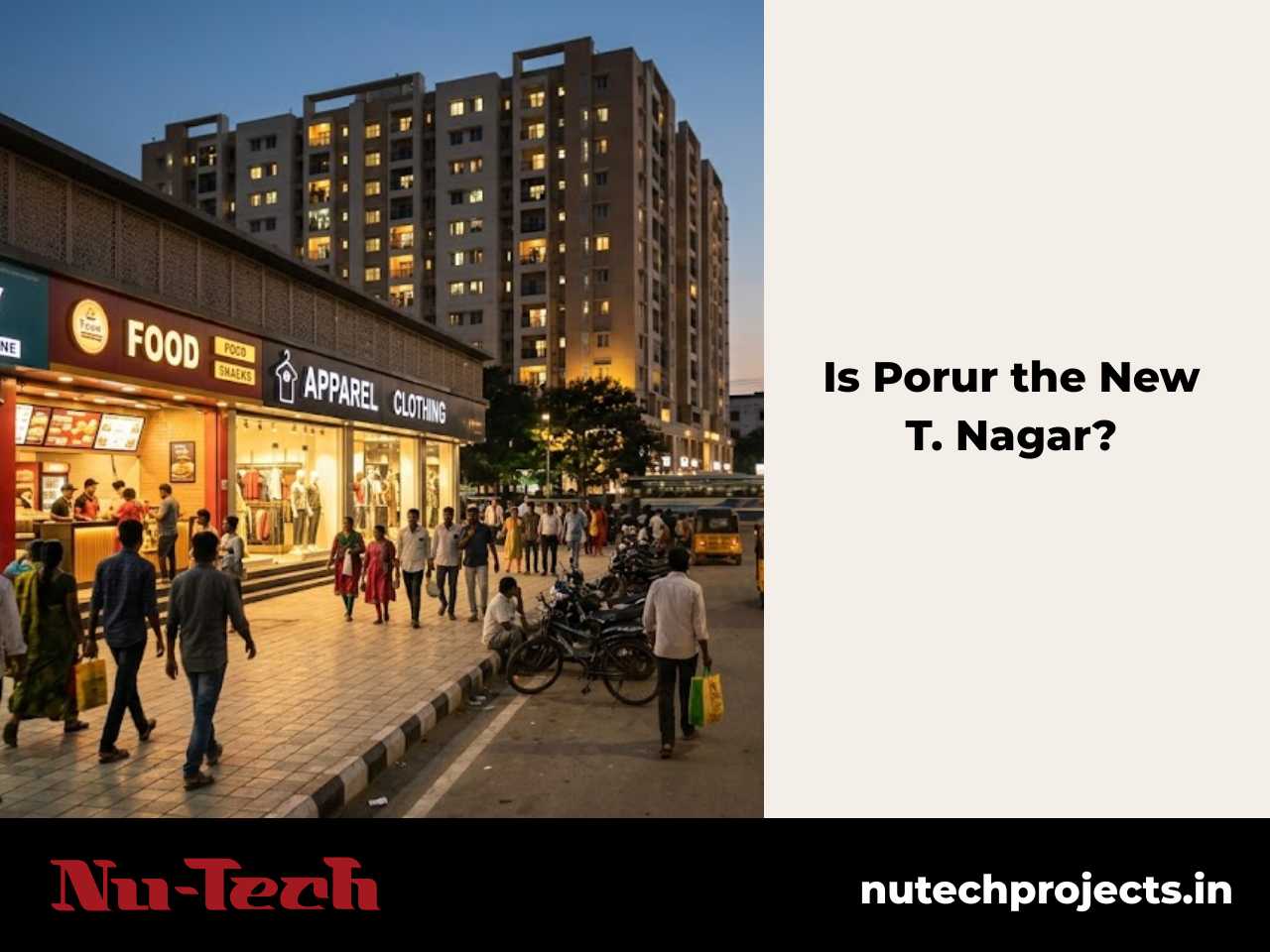
Is Porur the 'New T. Nagar'? Analyzing the Shopping and Retail Explosion
Posted on :
T. Nagar earned its reputation over decades. Porur is earning it in years. If you have been watching this western suburb closely, you already know something has shifted. The streets that were quiet five years ago now have branded retail outlets, dense food court strips, weekend crowds, and a commercial energy that catches first-time visitors off guard. This is not just neighbourhood growth. It is a structural transformation of how Porur functions as a city node, and it matters enormously to anyone thinking seriously about buying a home here.
What T. Nagar Actually Represents (and Why the Comparison Matters)
Calling any neighbourhood "the new T. Nagar" is a loaded claim. T. Nagar is not just busy. It is Chennai's most commercially dense residential zone, where real estate values have held strong across three decades precisely because you never have to go far for anything. Schools, hospitals, jewellery, textiles, restaurants, banks, daily needs, weekend outings: all within a two-kilometre radius.
That mix of retail density and residential demand is the benchmark. When people make this comparison for Porur, they are not saying Porur will replace T. Nagar. They are saying Porur is beginning to develop that same self-contained quality, where daily and discretionary spending can both be met locally. For a buyer, that kind of neighbourhood fundamentally changes how you live in your home.
The Retail Anchors That Changed Porur's Commercial Identity
The transformation is not informal. It is anchored. The presence of Phoenix Marketcity at Velachery is a twenty-minute drive, but Porur's own retail corridor along the Mount-Poonamallee High Road and its feeder roads has developed its own pull. You now have organised grocery retail, pharmacy chains, QSR brands, apparel outlets, electronics stores, and cloud kitchen clusters operating within the locality itself.
VR Chennai Mall at Ambattur sits to the north. Grand Square Mall near Porur junction has brought a multiplex, food anchors, and weekend footfall to the locality directly. These are not aspirational developments. They are operational, visited, and integrated into how residents run their week. Retail follows rooftops, and Porur has added enough residential density over the last decade to sustain serious commercial investment.
Infrastructure and Footfall: The Real Engine Behind Retail Growth
Retail does not grow in isolation. It grows where people move through. Porur sits at the junction of the Chennai Bypass, Old Mahabalipuram Road (OMR) via Perungudi, and the Mount-Poonamallee corridor, making it one of the highest-traffic nodes in western Chennai.
The upcoming Vadapalani to Poonamallee metro corridor changes this further. Once operational, it will bring a new daily commuter base through Porur, turning occasional visitors into regular shoppers and, in turn, attracting retailers who need guaranteed footfall to justify their lease commitments. Infrastructure development in Porur has consistently preceded commercial expansion here, and the pattern shows no sign of stopping.
What the Retail Boom Means for Residential Demand
Here is the connection that directly affects buyers. Retail density is not just a convenience metric. It is a price signal. Areas with high commercial activity have lower vacancy rates in residential buildings, stronger resale markets, and higher rental yields. Tenants and buyers both prioritise neighbourhoods where life outside the flat is functional and accessible.
This is one of the core reasons homebuyers are choosing Porur over comparable options further from the city. When you add the employment density from the tech parks along the OMR and Guindy clusters to a growing retail ecosystem, you get a neighbourhood with genuine live-work-shop infrastructure. That is rare in Chennai at Porur's price point, and it is exactly what sustains demand in the medium to long term.
Where Porur Still Differs From T. Nagar
Honest analysis requires this caveat. Porur is not T. Nagar, and there are ways it should not try to be. T. Nagar's retail density comes with congestion, parking shortages, narrow internal roads, and a built environment that has very little room left to evolve. Porur, at this stage of its development, still has space: wider roads, newer buildings, more planned developments, and less of the chaotic layering that makes T. Nagar both vibrant and difficult.
The retail explosion in Porur is happening within a more modern urban form. That is arguably better for residents. You get the commercial energy without the gridlock. Buyers who have looked at what defines quality living in Chennai today will recognise that neighbourhood liveability is as much about what is absent as what is present.
The Buyer's Real Question: Does This Retail Growth Last?
Short-term retail booms collapse when driven by speculation alone. Long-term growth sticks when resident population, employment proximity, and infrastructure investment all move together. In Porur, all three are present and reinforcing each other.
The IT corridors along OMR and Guindy feed a working population within commuting distance. The metro project creates infrastructure permanence. The residential pipeline ensures the customer base that retail needs to stay viable. This is not a bubble. It is a neighbourhood crossing a threshold that Chennai's most established localities crossed years ago.
Retail follows people. People follow jobs and infrastructure. Both are pointed firmly at Porur.
For a full picture of the locality, price trends, and what to look for before you commit, start with the Flats in Porur — The Complete 2026 Buyer's Guide.
Previous page: The 'Manapakkam Spillover': Why Buyers Are Moving Slightly Out for More Space
Next page: The 'West Chennai Premium': Why Porur Flats Cost More Than 5 Years Ago — And Why That's Good

 Whatsapp
 Call
Call