

Why Porur Is
Seeing So Much
Infrastructure Attention
Posted on:

Over the past few years, Porur has quietly become one of the most closely watched growth corridors in West Chennai.
From the Chennai Metro Phase II corridor connecting Poonamallee to Porur to continuous road improvements along the Mount–Poonamallee Road stretch, infrastructure work in this region is happening step by step. Each upgrade may look small on its own, but together they signal something important: Porur is clearly on the government’s long-term development radar.
The Metro Corridor
That Is Reshaping Connectivity
One of the biggest developments around Porur is the Chennai Metro Phase II expansion, particularly the corridor connecting Poonamallee, Porur, and Vadapalani, which will link West Chennai to the city’s existing metro network. The Chennai Metro Phase II project spans nearly 118 km across the city, making it one of the most significant infrastructure developments currently shaping Chennai’s future mobility.
Once operational, this line will significantly improve how residents travel between West Chennai and the rest of the city. Instead of depending entirely on road traffic, commuters will have a reliable, high-capacity transit option connecting key residential and employment hubs.
Metro corridors typically reshape neighbourhoods around them. Areas that were once considered outer suburbs gradually evolve into well-connected urban residential zones, attracting both homebuyers and developers.
Porur is already beginning to see that transition.
Road Improvements That Support a Growing Corridor
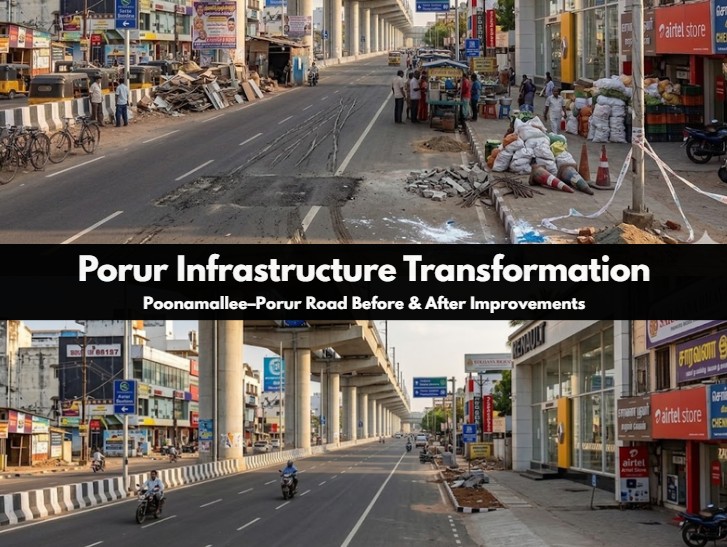
Alongside the metro development, authorities have also been clearing long-standing encroachments along the Poonamallee–Porur stretch to widen the road and improve vehicle movement.
For years, this corridor struggled with traffic bottlenecks caused by narrow carriageways and roadside extensions. Clearing these obstacles allows the road to be widened and better organised, making daily commuting smoother.
More importantly, it shows how infrastructure work in the area is being addressed systematically rather than in isolation.
First came the metro corridor development.
Then road widening initiatives.
Next, traffic management and urban upgrades.
Each step strengthens Porur’s position as a key residential hub.
What This Means for Homebuyers
When governments consistently invest in infrastructure within a specific corridor, it usually reflects long-term planning for urban growth.
For homebuyers, this translates to several advantages:
- Stronger long-term connectivity
- Better daily commute options
- Higher livability in surrounding neighbourhoods
- Increased real estate demand over time
This is one of the reasons why Porur continues to attract buyers looking for well-connected homes in West Chennai.
Porur’s Growth Is Being Built Step by Step
Urban transformation rarely happens overnight. It happens through consistent infrastructure upgrades that gradually reshape a neighbourhood.
The developments happening across the Poonamallee–Porur corridor suggest that Porur is moving steadily in that direction.
For homebuyers researching apartments in Porur, the steady pace of infrastructure development around the neighbourhood offers greater confidence in its long-term livability and connectivity.





 Whatsapp
 Call
Call