

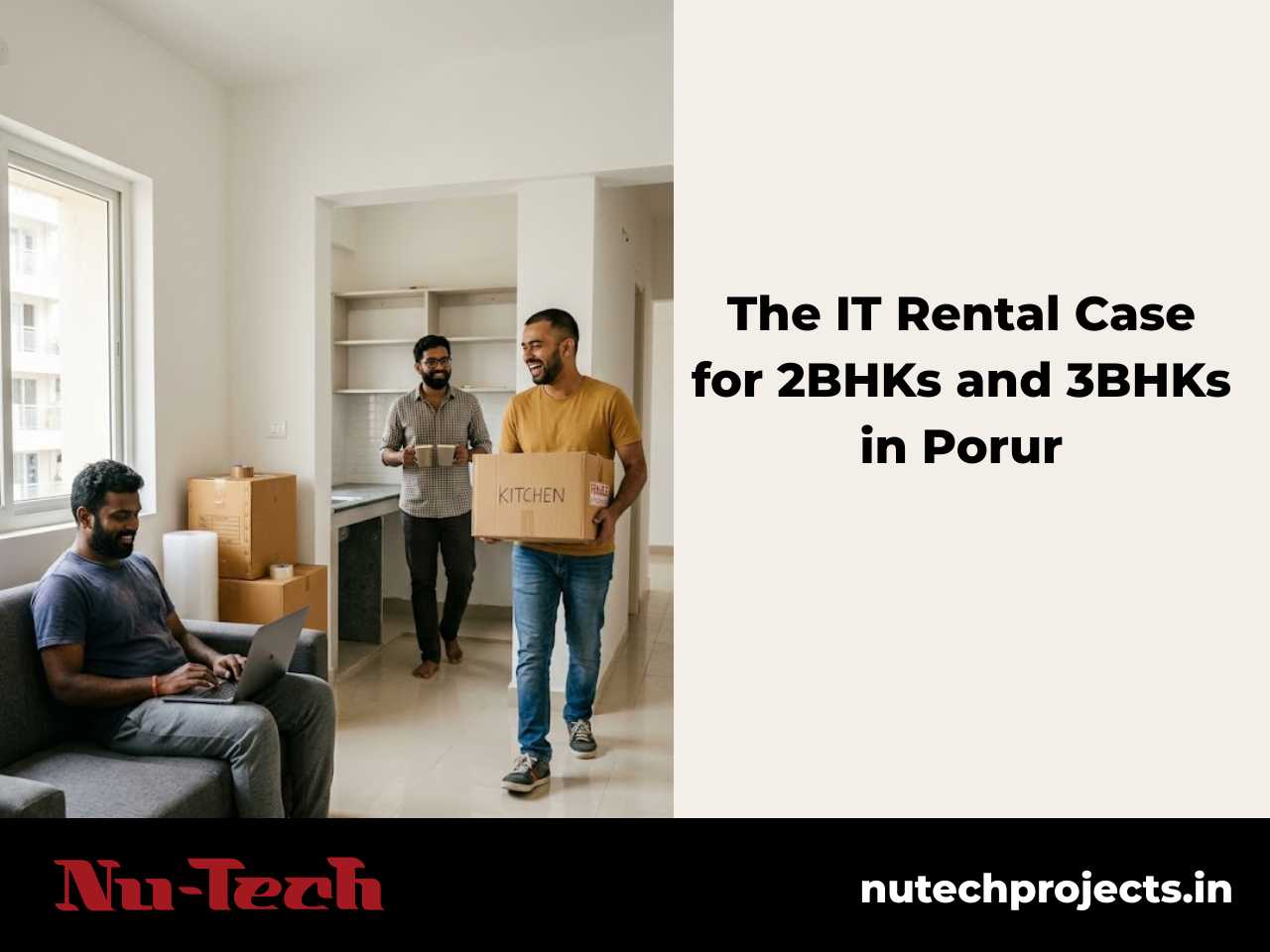
Rental Demand from IT Bachelors: Why 2BHKs and 3BHKs in the Porur Belt Are Worth Your Attention
Posted on :
Here is something that does not get said enough: the most reliable tenant in Chennai right now is not a family waiting for school admissions to begin. It is a 27-year-old software engineer, probably from Coimbatore or Trichy, earning somewhere between eight and fourteen lakhs a year, splitting rent with a colleague, and actively hunting for a decent 2BHK apartment in Porur. He is not asking for marble flooring. He wants a gym that actually has equipment, a parking slot, and a building that does not flood in October. He has found that Porur checks those boxes in ways that Velachery or Sholinganallur sometimes do not, at a price point that still makes sense.
If you are an investor considering flats in Porur, that person is your future tenant. And there are a lot more of him than the market seems to have accounted for.
Why Porur Specifically, and Not Somewhere Cheaper
People outside this corridor sometimes ask why Porur and not, say, Ambattur or Tambaram. The answer is geography and it is harder to argue with than most things in real estate.
Porur sits where the Outer Ring Road, Mount-Poonamallee Road, and the OMR access routes effectively converge. An IT professional working at a tech park in Ramapuram can get there in twelve minutes on a clear morning. Someone commuting to Perungudi or Sholinganallur can take the ORR and manage it without routing through the city. That connectivity also works in reverse: Porur residents can reach the airport, Guindy, or Anna Nagar without the kind of commute that turns good neighbourhoods into bad decisions.
Tambaram is cheaper per square foot, yes. But an engineer working in the DLF cluster near Ramapuram is not going to commute from Tambaram for five years voluntarily. Location premium in Porur is not vanity pricing. It is the cost of being where the tenant actually wants to live.
The Flat-Sharing Math That Makes 2BHKs and 3BHKs Move First
Walk into any property management office in Porur and ask them which units rent out fastest. It will not be 1BHKs. The IT bachelor's preferred arrangement is remarkably consistent: two colleagues, one 2BHK, shared rent of around Rs. 18,000 to 24,000 per month, each paying roughly nine to twelve thousand. Or three people splitting a 3BHK in the Rs. 28,000 to 35,000 bracket, each paying under twelve thousand, with an extra room that doubles as a home office.
That math works for the tenant at almost every income level in the sector. And because the model is so repeatable, these apartments rarely sit vacant between tenancies. One occupant moves on, they find a replacement from their own office network before the agreement lapses. The landlord barely has to intervene.
Porur currently delivers a rental yield of around 4%, with average monthly rents touching Rs. 28,000, which compares well against Velachery and Sholinganallur. That yield, combined with what has been quietly strong capital appreciation in this corridor, makes the investment case more coherent than single numbers usually suggest. The blog on Renting vs Buying in Porur covers that trade-off in more detail if you want to see it laid out for end-users as well.
What These Tenants Actually Screen For
This is where a lot of investors miscalculate. They assume IT tenants will take anything reasonably priced in a decent location. That was true ten years ago. Today, a mid-level tech professional has seen enough good apartments to know what bad ones smell like.
The screening is quick and fairly unforgiving:
-
Power backup for individual units, not just common areas. These tenants work late, take calls from home, and cannot afford a two-hour outage on a Tuesday night.
-
Covered parking with enough slots. Almost everyone in this demographic has at least a two-wheeler, and many have a car by their late twenties.
-
A gym that is actually functional, not a room with one broken treadmill and a dusty exercise bike from 2015.
-
Broadband-ready infrastructure, either direct fibre or proper conduit so providers can set it up without running cables across the ceiling.
-
A building entrance and lobby that does not feel unsafe at midnight, because these are people coming home late from office or from the airport.
Beyond the physical checklist, there is the building management question. Is the maintenance association responsive? Does the building have a WhatsApp group where things actually get fixed? Is there security that functions past 10 PM? These are the filters that separate a Rs. 24,000 rent from a Rs. 19,000 rent in the same locality, and they are controlled entirely by the builder's initial investment and the community's ongoing management.
This is precisely why builder reputation matters even in investment purchases. The argument is laid out well in the blog on: Buying Flats in Chennai? Choosing Reputed Builders Is the Safer Way.
The Metro Factor Is Arriving, Not Already Priced In
Chennai's metro Phase 2, specifically the Vadapalani to Poonamallee corridor, will run directly through the Porur belt. When that line is operational, the calculus for every tenant who currently hesitates because they do not own a vehicle changes entirely. The metro makes Porur reachable from a much wider professional catchment area, not just those with bikes or cars.
The Phase 2 metro extension toward Porur is widely expected to drive 30 to 50% property appreciation in the corridor once it opens. That is the kind of upside that rental yield alone does not capture. Right now, investors are still buying into a Porur that is pre-metro in pricing. That window is not permanent.
The metro is only part of the infrastructure story. Road access, the ORR connectivity, and what is coming next for this corridor are all covered in How Infrastructure Development Is Transforming Porur, and it is worth reading before you fix your budget.
What to Watch Out For
Not every project in Porur is built for this tenant. Some are skewed toward larger family configurations, price points that compress yield, or locations that add twenty minutes to a commute an IT professional will not tolerate for long.
Watch these specifically:
-
Projects priced above Rs. 1.2 crore in the 3BHK segment often attract families, not bachelors. The tenant profile shifts and so does your vacancy pattern.
-
Full furnishing sounds like a premium play but usually becomes a maintenance cycle. Semi-furnished is the sweet spot for this market.
-
Buildings with first-come-first-served parking fill up badly in bachelor-heavy occupancy. Check if parking is allocated per unit before you buy.
How to Evaluate a Project for Rental Suitability Before You Buy
Most investors visit a project asking about views and finishes. The questions that actually predict rental performance are different:
-
What percentage of units in completed phases are currently tenanted?
-
Is there a functioning residents' association, and what does maintenance cover?
-
Does society allow standard 11-month agreements without restrictions?
-
Is parking allocated per unit or first-come-first-served?
-
Is the building broadband-ready, or will tenants be running cables across ceilings?
If the sales team cannot answer these fluently, that is your answer. The [Chennai Homebuyer Checklist] has more questions worth taking into any site visit.
The Honest Investment Case
The demand is already here. The metro is coming. The supply of well-built, amenity-rich apartments from credible developers in this belt is not unlimited.
The 2BHK and 3BHK segments are where the rental case is strongest and most durable. Get the project right, get the sub-location right, and this is the kind of investment that does not keep you up at night.
For everything else you need before committing, start with the Flats in Porur — The Complete 2026 Buyer's Guide.
Previous page: The 'West Chennai Premium': Why Porur Flats Cost More Than 5 Years Ago — And Why That's Good
Next page: What AI Predicts for Porur Flat Returns Over the Next 10 Years

 Whatsapp
 Call
Call