

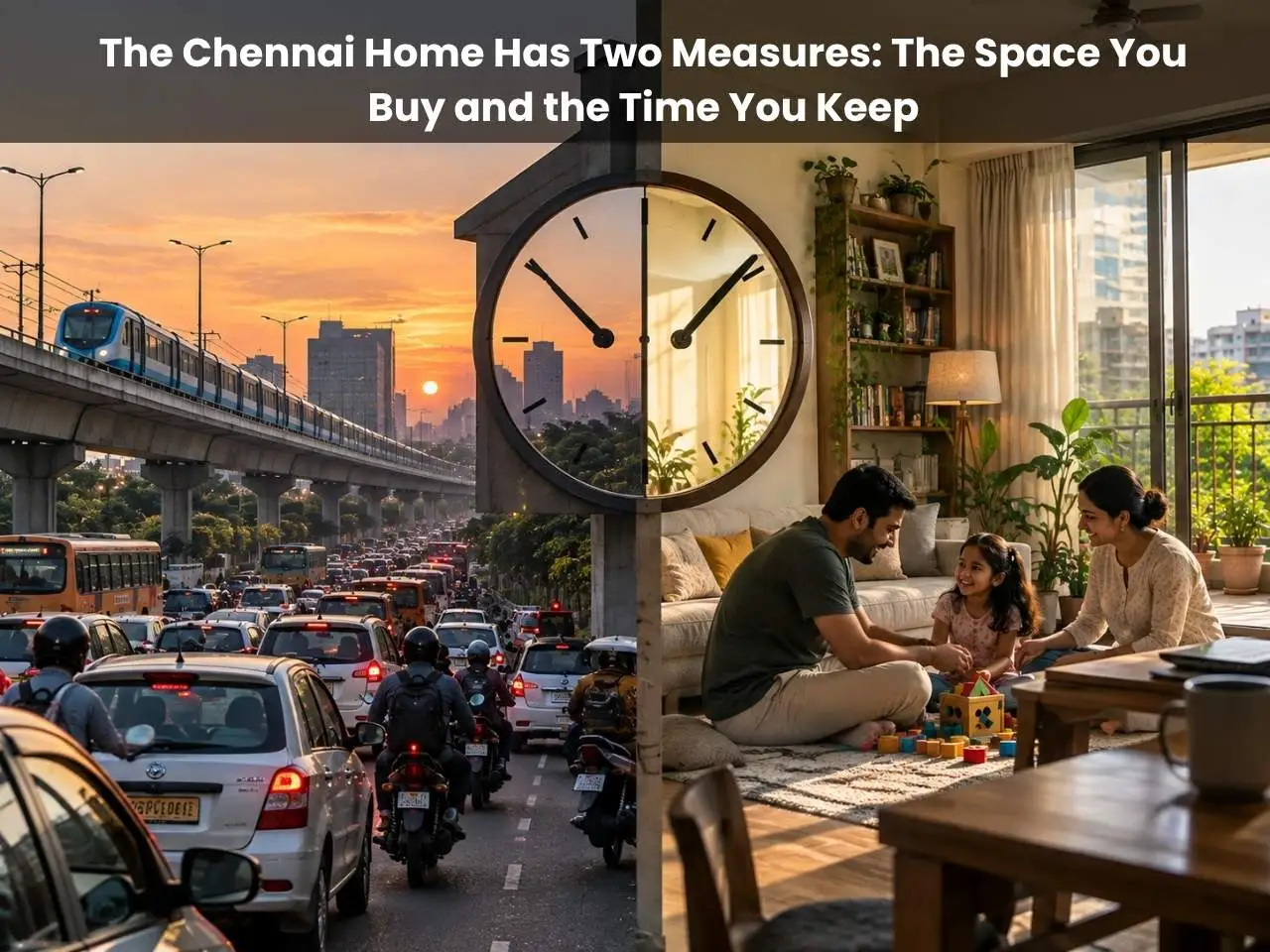
The Chennai Home Has Two Clocks: The Commute Clock and the Family Clock
Posted on :
Written by : Farvesh Ahamed 

Ask a Chennai buyer how far a shortlisted flat is from the office and the answer usually comes in kilometres. The figure that shapes daily life is a different one: the time each working member of the household gets home on a weekday evening. TomTom's 2025 Traffic Index puts the average 10 km drive in Chennai's city area at 33 minutes 54 seconds in the morning rush and 41 minutes 6 seconds in the evening rush. The trip home is the slower one.
That gap is a useful way into commute time and home buying in Chennai, because every location sets two clocks. The commute clock counts what a location costs in travel on each weekday. The family clock is set by the fixed times a household runs on, such as a school pickup or dinner. What you are looking for is a location where both clocks can be kept, for every earner, for as long as you expect to own the home.
How commute time affects home buying in Chennai
Commute time shapes a Chennai home purchase because a flat's location fixes how long each working member of the household spends on the road on every office day, and the slowest part of that travel falls in the evening. Measuring a location in peak-hour minutes for each earner, rather than in kilometres to one office, shows what it costs in time.
The commute clock is the easier one to read: the door-to-door time of each regular trip at the hour you actually make it, multiplied by the number of days you make it. The family clock is harder to see because it is made of commitments rather than journeys, such as a child's school pickup or an older parent's hospital appointment. Those commitments keep fixed times. Road travel doesn't, and choosing a location is largely a choice about how often the two will collide.
There is no single best location to buy a home in Chennai on commute grounds, because the answer depends on where a particular household's trips go and at what hour.
The trip home is the slower one
TomTom builds its index from anonymised driving data. For Chennai's city area in 2025, it recorded average rush-hour speeds of 17.7 km/h in the morning and 14.6 km/h in the evening. Taking all times of day together, a 10 km drive took 31 minutes 15 seconds on average. In the evening rush, the same distance took 7 minutes 12 seconds longer than in the morning rush.
At the city-area averages, every additional 10 km between home and office adds about 34 minutes to the morning drive and about 41 minutes to the drive back. These averages cover many routes, so a particular road may be faster or slower. Roads outside the city area may also move at a different pace. Even so, the averages show where the cost of distance falls. The morning drive ends at a desk. The evening drive ends at home, and its extra minutes come out of dinner, homework and the last waking hour of a young child's day. That makes the evening return the commute time in Chennai to test first when comparing two flats.
Office days multiply the cost
The commute clock only runs on the days you travel, so the number of office days a job requires belongs in the location decision. At several large IT services employers, attendance rules have tightened since early 2025. Infosys began enforcing a minimum of 10 office days a month from 10 March 2025, Wipro required at least six hours in the office on each of three office days a week from 1 January 2026 and TCS expected staff in the office five days a week as of January 2026. Each extra office day is one more evening on the commute clock.
For one earner, extra travel time adds up as follows. The figures are simple arithmetic.
| Extra travel time each way | Per week, 5 office days | Per week, 3 office days | Per year, 5 office days over 48 weeks |
| 15 minutes | 2.5 hours | 1.5 hours | 120 hours |
| 30 minutes | 5 hours | 3 hours | 240 hours |
| 45 minutes | 7.5 hours | 4.5 hours | 360 hours |
| 60 minutes | 10 hours | 6 hours | 480 hours |
A location that feels fine on a three-day week costs two-thirds more time on a five-day week. Jobs and office rules can both change while a home loan runs, so test each shortlisted flat against the strictest office week you might face. Hybrid work has cut commute days for some households and changed what Chennai homebuyers want from a home, but it hasn't taken the commute out of the decision.
Is a cheaper home farther from work the better buy?
A lower price farther from the office is the better deal only when the money saved is worth more to the household than the time lost. That depends on how many office days each earner has, how the trip is made and how long the arrangement is likely to last.
The trade-off can be put in numbers. Start with the difference in EMI, the equated monthly instalment that repays a home loan, between the two homes on the same loan terms. Subtract any extra fuel, tolls or fares the farther home would add each month. Divide what is left by the extra hours of travel the farther home adds each month for all earners combined, timed at peak hours. The result is what the household is being paid for each hour it gives up, and the household can then decide whether that rate is acceptable.
Two corrections keep the comparison honest. The first is space. A bigger flat farther out is only bigger in use if its carpet area is, and the advertised size may be the super built-up area, so check the difference between carpet area, built-up area and super built-up area before counting the extra room as a gain.
The second is time. The EMI saving is fixed for the life of the loan, while the commute can change whenever the job or the rail map does. A farther home is easier to justify when the household's office days are few or its trips run by rail, and when the loan stays within a comfortable share of take-home income, so that a later move or a longer commute does not strain the budget.
The family clock runs on fixed times
Family time and home location meet in a few fixed moments of the weekday, such as the school gate at the end of the day and the stretch before a young child sleeps. None of them move when the traffic does. When the evening commute ends at a different time every day, whoever reaches home first ends up covering for whoever is still on the road. So the question to ask of any flat is whether the person leaving work at 6 pm gets home while the children are still awake, and whether someone can reach the school gate on time.
Two earners make this harder, because their offices often lie in different directions. If one of you works at DLF Cyber City in Manapakkam and the other on OMR, a flat in Porur keeps the first trip short and sends the second across the city twice a day. A flat on OMR reverses the problem. Compare locations on the combined travel time of both earners and on the longer of the two evening trips, because whoever has the longer trip is the one least able to make the school pickup.
Children's school runs add more trips to the commute clock, and a school close to home shortens the trip that is hardest to reschedule. Proximity to schools and hospitals is among the things Chennai parents weigh when choosing a gated community, and for a household with long commutes it carries extra weight.
Predictable travel time can matter more than short travel time
A trip that takes the same time every evening lets you tell the family when you'll be home. A shorter trip that varies from day to day doesn't, and on the family clock that matters. Trains run to a timetable on their own track, so rail tends to be more predictable than road. That holds for the metro and for Southern Railway's suburban lines, such as Chennai Beach to Chengalpattu through Tambaram, which reach farther out than the metro does today.
Two Phase 1 lines make up Chennai's operational metro: the Blue Line from Wimco Nagar Depot to Chennai Airport and the Green Line from Chennai Central to St Thomas Mount. As of early October 2026, the first Phase 2 stretch, 14.64 km from Poonamallee Bypass to Vadapalani through Porur, had safety clearance and was scheduled to be inaugurated on 11 October 2026, with trains expected every 10 minutes at first. Vadapalani is also on the Green Line.
Homes near metro stations in Chennai get a timetable for part of the trip only if the line goes where the household's trips go. For buyers in Porur, what the Vadapalani to Poonamallee metro means for daily life will depend on where each earner works and on the walk or ride between the station and the gate, which still runs on local roads and needs timing too.
A commute test to run before you book
Choosing a home based on commute time means making the trips yourself, because a distance figure cannot show the evening rush. A practical order for doing it:
1. List every regular trip in the household, including each earner's office, the school and any standing weekly appointment, with the time each trip must start or end.
2. Travel from each workplace to the flat on a weekday evening, leaving at your usual hour and using the mode you plan to use. Make the morning trip as well, since the two will differ.
3. Time the whole journey door to door, including parking, the walk to a platform and the wait for a cab or train.
4. Check the route in rain if your timeline allows. During the northeast monsoon, between October and December, waterlogged streets can slow or close parts of a route, so look at the roads leading to the project as well as its entrance and ask residents how those roads held up last season.
5. Confirm how many office days each employer requires now, then rerun the numbers for a five-day week.
6. Time one more trip for each earner, to a second employment area where they could realistically work, because the home may outlast the current job.
How much commute time is too much when buying a home in Chennai?
No official standard says how long a commute can be before a Chennai home becomes the wrong choice. The practical limit is set by the family clock: an evening trip is too long when it regularly keeps someone from being home at the time the household needs them.
Working back from that time gives each earner a latest departure, and a location has to meet it on most weekdays. Office rules and the metro network may both change after you buy, as new Phase 2 stretches open and employers revise attendance policies. Neither is a sound basis for buying on expectation. A flat that keeps both clocks on today's roads and today's office week makes any later improvement a bonus the family never had to count on.
Frequently asked questions
Does location matter when buying a home in Chennai if I go to the office only some days?
Yes. Fewer office days mean fewer commutes, but the commute does not disappear. The rules can also change. Infosys, Wipro and TCS all set or enforced stricter office attendance rules in 2025 and 2026, so a location chosen for a two-day week should still be workable on five.
What time of day should I test a commute in Chennai?
Test the evening return on a weekday at the hour you would normally leave work. TomTom's 2025 data for Chennai's city area shows a 10 km drive averaging 41 minutes 6 seconds in the evening rush against 33 minutes 54 seconds in the morning rush. Time the morning trip too, for every earner in the household.
Will a home near a new metro station be worth more?
The link between commute and property value cannot be read from proximity alone. Prices near a station also move with the wider market, so a station nearby does not by itself show that a home will gain value. What an operational station changes with more certainty is how predictable trips along that line become.
Is the Poonamallee to Vadapalani metro line open?
As of early October 2026, the 14.64 km stretch had safety clearance and was scheduled to be inaugurated on 11 October 2026. Its expected opening has moved more than once, so check Chennai Metro Rail Limited's current service information before planning a daily commute around it.





 Whatsapp
 Call
Call