

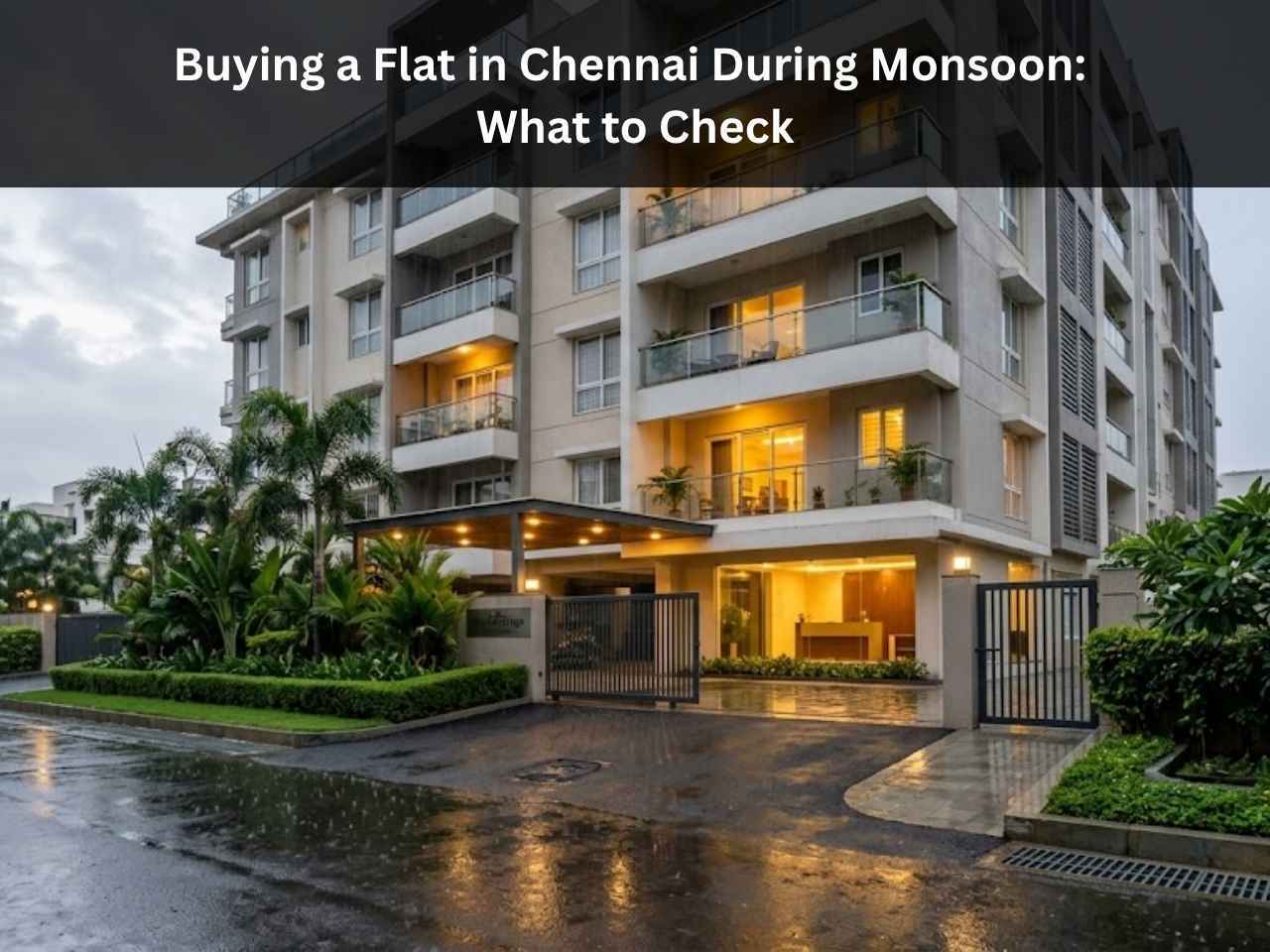
Buying a Flat in Chennai During Monsoon: What to Check
Posted on :

Most homebuyers visit a property when the weather is at its best.
The sun is out, the roads are dry, the apartment looks bright, and the sample flat is presented exactly as you would expect. But in Chennai, there is another side of a property that only becomes obvious when the rain arrives.
From October to December, the northeast monsoon can reveal things that a brochure, sample flat or regular weekend site visit cannot: waterlogging on the approach road, seepage in parking areas, poor stormwater flow and drainage systems that struggle during
heavy rainfall.
That makes the monsoon an unexpectedly useful time to evaluate a home.
If you're looking for a flat in Chennai for sale, here's what you should actually check before
making your decision.
1. Look Beyond the Project's Address
Two projects can be located in the same neighbourhood and still experience very different conditions during heavy rain. The difference can come down to the site's elevation, surrounding roads, nearby water bodies, natural drainage patterns and how stormwater moves
through the locality.
So don't stop at asking whether the area is prone to flooding. Ask whether the project site sits higher or lower than the surrounding road, where rainwater from the road eventually flows, and whether there are low-lying stretches nearby that tend to hold water. It also helps to ask how the site has handled particularly heavy spells in the past, and whether the surrounding streets have had any history of waterlogging.
For buyers considering apartments in Porur, it is also worth understanding how the area's wider infrastructure is evolving. Looking at the infrastructure development taking place in Porur can give you a better sense of how connectivity, roads and other urban improvements may influence the locality over time.
2. Don't Ignore
the Basement or
Stilt Parking
The parking area can tell you a lot about how a building handles rain.
If possible, visit the project during or soon after a heavy downpour. Walk through the basement or stilt parking instead of simply looking at it from the entrance.
Look for:
-
Water accumulation near ramps or entrances
-
Damp patches on walls
and ceilings -
Water stains around columns
-
Signs of repeated seepage
-
Unusual musty smells
-
Areas where water appears
to collect
Also ask where rainwater collected from ramps and other open areas
is directed.
A well-designed parking area should have a clear system for managing rainwater rather than relying on it simply to drain away.
3. Ask How the Stormwater System Actually Works
"Good drainage" is easy to promise. The more useful question is: how does the system work?
When speaking to the sales team, ask:
-
Is stormwater drainage separate from sewage lines?
-
Where does rainwater from the property go?
-
Are there recharge pits or rainwater harvesting systems?
-
How is excess water handled during heavy rainfall?
-
How are drains and collection points maintained?
In Tamil Nadu, rainwater harvesting is a legal requirement for buildings, so this isn't just a nice-to-have question, it's worth confirming the project actually complies. These questions may not be as exciting as asking about a clubhouse or swimming pool, but they have a much greater impact on your everyday experience during Chennai's rainy months. The same principle applies when evaluating other project features. Look beyond the brochure and understand whether the amenities offered in a gated community are genuinely designed around residents' day-to-day needs.
4. Check the Road to Your Home, Not Just the Project Entrance
A project can have excellent drainage within its boundary and still be difficult to access if the surrounding roads flood.
This is why your site visit shouldn't end at the project gate.
Drive around the last few hundred metres leading to the property. Look at the approach roads, junctions and connecting streets. If it has rained recently, check whether water is still standing in low-lying stretches.
Also consider your regular routes.
How will you get to work during a heavy shower? What about school runs, grocery trips or getting to the main road? A property that looks well-connected on a map may feel very different when you're navigating waterlogged roads.
Chennai's larger water-management and infrastructure projects can also influence how different parts of the city develop over time. The ongoing Buckingham Canal revamp, for example, is something buyers can consider when thinking about the city's longer-term approach to water management and
urban infrastructure.
5. Ask About Waterproofing in Specific Terms
Don't stop at asking, "Is the building waterproofed?"
Ask what has actually been done.
Terraces, external walls, bathrooms, balconies and window areas are some of the places where water-related problems can eventually become visible. Ask the builder about the waterproofing methods used in these areas and whether the specifications can be
shared with you.
If you're buying an apartment that is already completed, look carefully at:
-
Ceiling corners
-
Bathroom walls
-
Balcony edges
-
Window frames
-
External walls
-
Areas below terraces
Small signs of dampness don't automatically mean there is a serious structural problem, but they are worth investigating before you make a commitment.
6. Find Out What Happened During the Last Monsoon
If an earlier phase of the project is already occupied, you have a valuable source of information right there: the residents.
Speak to people who have actually lived through a monsoon in the community. You don't need a long conversation, just a few direct questions. Ask whether the parking area flooded, whether there was any seepage inside the building, and whether water collected around the entrance during heavy spells. It's also worth asking if the lifts or common areas were affected at any point, and if so, how quickly the issue was sorted out.
Residents may give you a much more realistic picture of how the property performs in heavy rain than a standard sales presentation can.
7. Think About Chennai's Climate Before
Comparing Prices
When buying a home, it's natural to compare the obvious things: price, location, carpet area,
amenities and connectivity.
But a home is a long-term purchase. The climate it has to withstand should be part of that decision too.
Chennai's combination of intense summer heat, humidity and seasonal heavy rainfall means things such as ventilation, natural light, waterproofing, drainage and building orientation can affect how comfortable a home feels
over the years.
If you're comparing properties, our guide on how Chennai's climate should influence your home-buying decision can help you look at these factors beyond just the monsoon.
8. Don't Let a Beautiful Sample Flat Make the Decision for You
A sample flat is designed to help you imagine your future home. That's useful, but it is only one part of the buying decision.
Before you get carried away by the interiors, step outside.
Look at the road. Look at the parking area. Check the surrounding streets. Ask about drainage. Talk to existing residents if there are any.
And most importantly, visit the property more than once if you can.
A second visit after rain can sometimes tell you more than the first visit on a sunny afternoon.
Bring a Monsoon-Specific Checklist to Your Site Visit
You don't need to be a civil engineer to evaluate a property during the rainy season. You simply need to ask the right questions and pay attention to the surroundings.
Before your next site visit, check:
-
Project elevation compared with the surrounding road
-
Water accumulation around
the entrance -
Basement or stilt parking for signs of seepage
-
Condition of approach roads
-
Stormwater drainage arrangements
-
Rainwater harvesting and recharge systems
-
Terrace and external
wall waterproofing -
Signs of dampness around windows and balconies
-
Monsoon experience of
existing residents -
Access to the property during heavy rainfall
For the broader due-diligence involved in buying a home, you can also refer to our Chennai homebuyer checklist. Use it alongside these monsoon-specific checks to get a more complete picture before you make your decision.
A Good Home Should Work Beyond a Sunny Site Visit
Buying a home in Chennai means thinking about more than how the property looks on the day you visit it.
You are buying into the locality, the roads around it, the building's drainage and waterproofing systems, and the way the home performs through Chennai's changing weather.
So if you're house-hunting during the monsoon, don't see the rain
as an inconvenience.
Use it as part of your inspection.
A home that continues to feel safe, accessible and comfortable after a heavy Chennai downpour is giving you information that
no brochure can.
And that is exactly the kind of information worth having before you sign on the dotted line.





 Whatsapp
 Call
Call