

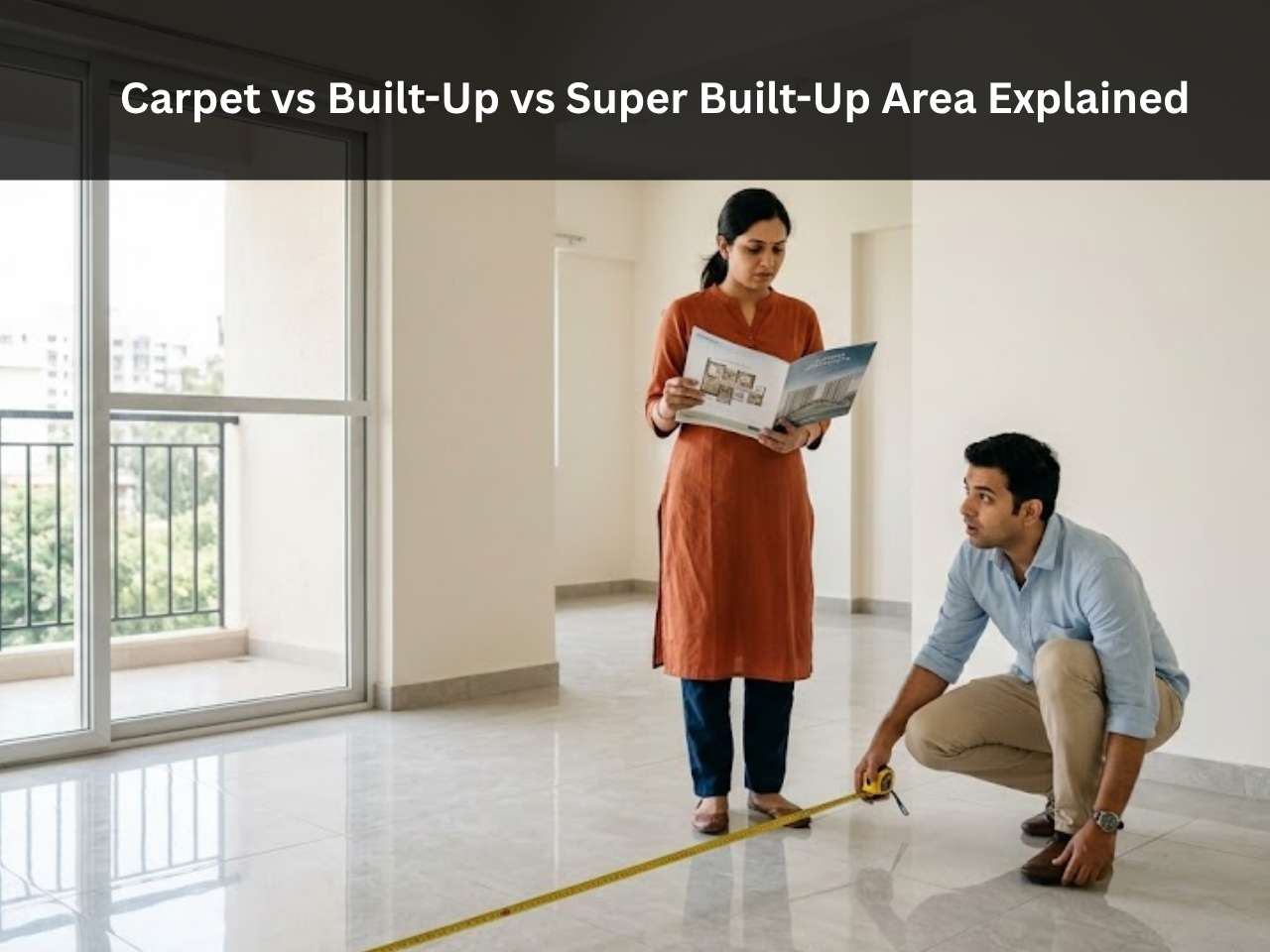
Carpet Area vs Built-Up Area vs Super Built-Up Area: How Much of Your Flat Are You Actually Paying For?
Posted on :

Imagine this. You spend a Saturday visiting two apartment projects in Porur. Both brochures say 1,400 sq ft. Both are 3 BHKs. Both are priced almost identically.
But when you walk through the sample flats, something feels off. The first one feels roomy. The living room comfortably fits a large sofa, a dining table for six, and still leaves space to walk around. The second one feels tight. The bedrooms look smaller, the kitchen feels like a corridor, and you cannot figure out why.
Same 1,400 sq ft. Completely different homes.
The answer is hiding in three words most buyers skim past in brochures: carpet area, built-up area, and super built-up area. Once you understand these three terms, you will never compare apartments the same way again. More importantly, you will never overpay for space you cannot actually use.
Let us break it all down the way a good advisor would, not the way a brochure does.
Carpet Area vs Built-Up Area in 30 Seconds
If you're short on time, here's the simplest way to understand the three measurements:
| Measurement | What It Includes | Why It Matters |
| Carpet Area | The usable space inside your apartment where you can place furniture and live comfortably | The most important number for comparing homes |
| Built-Up Area | Carpet area plus the thickness of walls, balconies, and utility spaces | Helps understand the physical footprint of the apartment |
| Super Built-Up Area | Built-up area plus your share of common areas like corridors, lifts, staircases, and amenities | Often used in brochures and marketing material |
Bottom line: If you're comparing two apartments, compare their carpet area, not just the advertised size.
What Is Carpet Area? (The Space You Actually Live In)
The carpet area is the simplest of the three to understand. It is the floor space inside your apartment that you can actually walk on and use. Think of it literally: if you rolled out a carpet across every room, the area it could cover is your carpet area.
It includes your bedrooms, living room, dining area, kitchen, bathrooms, and internal passages.
It does not include the thickness of external walls, your balcony (as per the RERA definition), common corridors, the lift lobby, or any shared space in the building.
Quick Tip: When a salesperson quotes a size, always ask, "Is that the carpet area or the super built-up area?"
This simple question immediately gives you a clearer understanding of what you're actually being offered.
The RERA Carpet Area: Why the Government Stepped In
Before 2017, apartment sizing in India was a bit of a free-for-all. Builders advertised super built-up area, buyers assumed it was livable space, and the gap between expectation and reality was often 30 to 40 percent.
The Real Estate (Regulation and Development) Act changed that. RERA defines carpet area as the net usable floor area of an apartment, including internal partition walls, but excluding external walls, service shafts, exclusive balconies, and open terrace areas.
Two things make this definition powerful for you as a buyer:
-
Builders must quote and register the carpet area. Every RERA-registered project must declare the carpet area of each unit on the state RERA portal. In Tamil Nadu, that is TNRERA. You can check it yourself before you ever visit a site.
-
You are protected if the delivered area falls short. If the carpet area handed over is less than what was promised in the agreement, the builder is required to refund the difference, with interest. That is not a courtesy. It is the law.
|
Did You Know? RERA carpet area includes the thickness of internal partition walls (the walls between your bedroom and living room, for example). So the RERA carpet area is usually slightly larger than the pure "usable" carpet area. It is a small difference, but worth knowing when you measure a flat yourself. |
What Is Built-Up Area?
Built-up area is your carpet area plus the structure around it. It adds:
-
The thickness of your external walls
-
Your balcony and utility areas
-
Any exclusive terrace or corridor attached to your unit
As a rule of thumb, built-up area runs about 10 to 15 percent higher than carpet area. So a flat with 1,000 sq ft of carpet area will typically have a built-up area of around 1,100 to 1,150 sq ft.
Here is the thing though: built-up area is mostly a technical measurement. You do not live inside your walls. Which brings us to the number that actually appears in most advertisements.
What Is Super Built-Up Area? (The Brochure Number)
Super built-up area is your built-up area plus your proportionate share of the building's common spaces. That includes the lobby, staircases, lift shafts, corridors, clubhouse, gym, and other shared amenities.
This is often called the saleable area, and historically it is the number builders used for pricing. Why? Because it is the biggest number available.
To be fair, this is not pure trickery. Common areas cost money to build, and every resident genuinely shares them. The problem was never that common areas were charged for. The problem was that buyers were never told how much of the "size" they were paying for was space they would never furnish.
The Comparison at a Glance
| Aspect | Carpet Area | Built-Up Area | Super Built-Up Area |
| What it covers | Usable floor space inside your flat | Carpet area + walls + balcony | Built-up area + share of common areas |
| Includes walls? | Internal partition walls only (RERA) | Internal + external walls | All walls + shared structures |
| Includes balcony? | No (per RERA) | Yes | Yes |
| Includes lobby, lift, clubhouse? | No | No | Yes, proportionately |
| Typical size relationship | Base (100%) | ~110 to 115% of carpet | ~125 to 140%+ of carpet |
| Who uses it | RERA, smart buyers | Architects, technical docs | Brochures, older pricing |
| What it tells you | How much home you get | How big the structure is | How much you are paying for |
Why Price Per Carpet Sq Ft. Matters More Than the Advertised Price
When buyers compare apartments, they often look at the advertised price per sq ft. Unfortunately, that number doesn't always tell the whole story because it may be based on the super built-up area rather than the space you'll actually live in.
A better way to compare homes is to calculate the effective price per sq ft of carpet area. This gives you a much clearer picture of how much you're paying for usable living space and makes it easier to understand whether a flat is genuinely overpriced, even when advertised sizes differ across projects.
Expert Tip: When comparing two apartments, divide the total price by the carpet area, not the super built-up area. It's one of the simplest ways to understand which home offers better value.
Loading Factor: The Percentage That Quietly Changes Everything
Loading factor is the gap between the super built-up area and the carpet area, expressed as a percentage. It tells you how much of the advertised size is not inside your apartment.
The formula is simple:
Loading % = (Super Built-Up Area − Carpet Area) ÷ Carpet Area × 100
Let us make it real.
Example: A flat is advertised at 1,400 sq ft super built-up. Its carpet area is 1,000 sq ft.
Loading = (1,400 − 1,000) ÷ 1,000 × 100 = 40%
That means for every 100 sq ft you pay for, 40 sq ft sits outside your front door.
Now, is 40% loading bad? Not automatically. A project with a large clubhouse, wide corridors, multiple lifts, and generous lobbies will naturally carry higher loading. A no-frills building might sit at 20 to 25 percent. What matters is whether the loading buys you amenities you will actually use, and whether you knew about it before you signed.
The 1,400 Sq Ft Trap: Two Flats, Same Number, Very Different Homes
Let us return to those two flats in Porur from the introduction and put numbers on them.
| Apartment A | Apartment B | |
| Advertised size | 1,400 sq ft | 1,400 sq ft |
| Loading factor | 27% | 42% |
| Carpet area | ~1,100 sq ft | ~985 sq ft |
| Price | ₹1.12 Cr | ₹1.12 Cr |
| Price per sq ft (advertised) | ₹8,000 | ₹8,000 |
| Price per sq ft of carpet area | ₹10,180 | ₹11,370 |
Both look identical on paper. But Apartment A gives you roughly 115 sq ft more actual living space. That is an entire extra bathroom, or a genuinely usable study, or the difference between a dining table for four and one for six.
And look at the last row. When you price both flats by carpet area, Apartment B is effectively 12 percent more expensive for the same money. This is exactly why the carpet-based rate matters.
How Carpet Area Affects Real Decisions (Not Just Definitions)
Furniture planning
Carpet area determines how your home actually functions day to day. A king-size bed typically requires around 42 sq ft including walking clearance on either side. A standard three-seater sofa with a coffee table needs 80 to 100 sq ft to feel comfortable, and a six-seater dining table requires roughly 90 sq ft to be genuinely usable rather than merely placed.
This is why room-wise dimensions matter as much as the total carpet area. Two flats with identical carpet areas can accommodate furniture very differently depending on how the space is distributed. Request a detailed floor plan with individual room measurements before booking, and map your key furniture against it. It is far easier to plan on paper than to discover after moving in that the wardrobe blocks the only window.
Resale value
Carpet area plays a direct role when you eventually sell. The buyer's bank valuation and legal due diligence will reference the carpet area recorded in your sale agreement, and informed buyers increasingly compare properties on a per sq ft of carpet area basis rather than the advertised size.
A flat purchased with a high loading factor faces the same scrutiny at resale that it should have received at purchase. Properties with efficient layouts and reasonable loading tend to hold their value better over time, simply because the usable space justifies the price more convincingly to the next buyer.
Rental yield
Rental income is driven by usable space, location, and condition, not by the size of the building's common areas. Two flats purchased at the same price but with different carpet areas will command different rents, which translates directly into different rental yields on the same investment. For buyers evaluating a property partly as an investment, carpet
Why Two Apartments with the Same Carpet Area Can Feel Completely Different
Even when two apartments have exactly the same carpet area, they don't always feel equally spacious. That's because good design is about how the space is planned, not just how much of it there is.
For example, one apartment may have a long internal corridor that takes away usable living space, while another uses an open layout that makes every square foot more functional. The placement of doors, windows, structural columns, and wardrobes can also influence how spacious a home feels.
Natural light and cross ventilation make a significant difference too. A bright living room with large windows often feels more open than a darker room of the same size.
This is why it's important to look beyond the numbers. During a site visit, study the floor plan, imagine where your furniture will go, and think about how you'll move through the home every day. An efficient layout can often feel larger and more comfortable than a bigger apartment with poor planning.
7 Questions to Ask at Your Next Site Visit
Even the most impressive sample apartment should be backed by clear, transparent information. These questions will help you evaluate the home beyond its appearance.
-
What is the RERA-approved carpet area of this specific unit?
-
What is the loading percentage, and which common areas are included in it?
-
Can you share a floor plan with room-wise dimensions?
-
How are the balcony and utility areas accounted for in the total area?
-
Is the price per sq ft calculated on carpet area, built-up area, or super built-up area?
-
Will the carpet area be clearly specified in the Agreement for Sale?
-
Does the sample apartment accurately reflect the dimensions and layout of the actual unit?
A transparent developer will be happy to explain each of these points, helping you make a confident and well-informed decision.
To know more about what to ask beyond area measurements, read our complete guide on questions to ask before buying a flat in Chennai.
Common Mistakes Buyers Make When Comparing Brochures
-
Comparing advertised sizes across projects.
Loading practices differ between developers, so one builder's 1,400 sq ft can equal another's 1,250 in usable terms. Always convert to carpet area before comparing. -
Assuming the balcony is part of the carpet area.
Under RERA it is excluded, even though it adds real value. Evaluate it as a separate line item. -
Overlooking the loading factor.
It is rarely highlighted in brochures, yet it decides how much of the advertised size lies outside your apartment. Ask for the exact figure in writing. -
Judging space from the sample flat.
Sample flats are staged to look larger than they are. Rely on the floor plan dimensions instead. -
Skipping the RERA portal check.
A project's declared carpet area is publicly listed on TNRERA. Verifying it takes a few minutes and confirms the figures independently.
Area confusion is only one of the traps buyers fall into. To know more, read our breakdown of the biggest mistakes people make when buying flats in Chennai.
Your Pre-Booking Checklist
Before you pay a booking amount for any apartment, confirm:
-
RERA registration number of the project, verified on the state portal
-
Carpet area of your specific unit, in writing
-
Loading percentage, and what it includes
-
Price per sq ft computed on carpet area, compared across your shortlist
-
Room-wise dimensions on the floor plan
-
Carpet area clause in the draft agreement of sale
-
Refund clause for carpet area shortfall at handover
If you are evaluating flats in Porur or anywhere along Chennai's western corridor, this checklist matters even more. The area has projects across every price band, and headline sizes vary widely in how they are calculated. Carpet area is the only common language across all of them.
FAQs
Which area should I check before buying a flat?
Carpet area. It is the space you will actually live in, it is the figure RERA requires builders to quote, and it is the number your agreement should be based on.
Does carpet area include the balcony? No. Under RERA, exclusive balconies are excluded from carpet area. They are usually listed and sometimes priced separately.
What is a good loading factor? There is no legal cap, but 25 to 35 percent is common for amenity-rich projects. Above 45 percent, question what you are paying for.
How do I calculate carpet area from super built-up area? Divide the super built-up area by (1 + loading factor). A 1,400 sq ft flat with 30 percent loading has roughly 1,077 sq ft of carpet area. If the builder will not share the loading figure, assume carpet area is around 70 to 75 percent of the advertised size and verify on the RERA portal.
Is the price of a flat based on carpet area or super built-up area? RERA requires builders to disclose and sell based on carpet area. In practice, always ask for the effective rate per sq ft of carpet area so you can compare projects fairly.
What happens if the builder delivers less carpet area than promised? Under RERA, you are entitled to a refund of the proportionate amount, with interest, for the shortfall.
Are RERA carpet area and usable carpet area the same? Almost. RERA carpet area includes internal partition walls, so it is slightly larger than the purely usable floor space.
The Real Takeaway: Buy Better Design, Not Bigger Numbers
The biggest number on a brochure isn't always the most important one. What truly shapes your everyday living experience is how much usable space your home offers and how intelligently that space has been designed.
Before you book an apartment, compare the carpet area, understand the loading percentage, and take the time to study the floor plan. These simple steps can help you make a more informed decision and ensure you're paying for the space you'll actually use.
If you're exploring apartments in Porur, don't let brochure sizes be your only benchmark. Compare homes based on their carpet area, layout efficiency, and overall design quality. A thoughtfully planned apartment often delivers far greater comfort than one that simply advertises a larger number.
Because when it comes to choosing the right home, it's not about buying more square feet. It's about making every square foot count.





 Whatsapp
 Call
Call