How Work from Home Permanently Changed What Chennai Homebuyers Want
Posted on :

With PM Modi calling on India to revive work-from-home practices once again, it's a good moment to step back and understand a shift that's been quietly reshaping Chennai's residential market since 2020, and what it means for anyone looking to buy a home today.
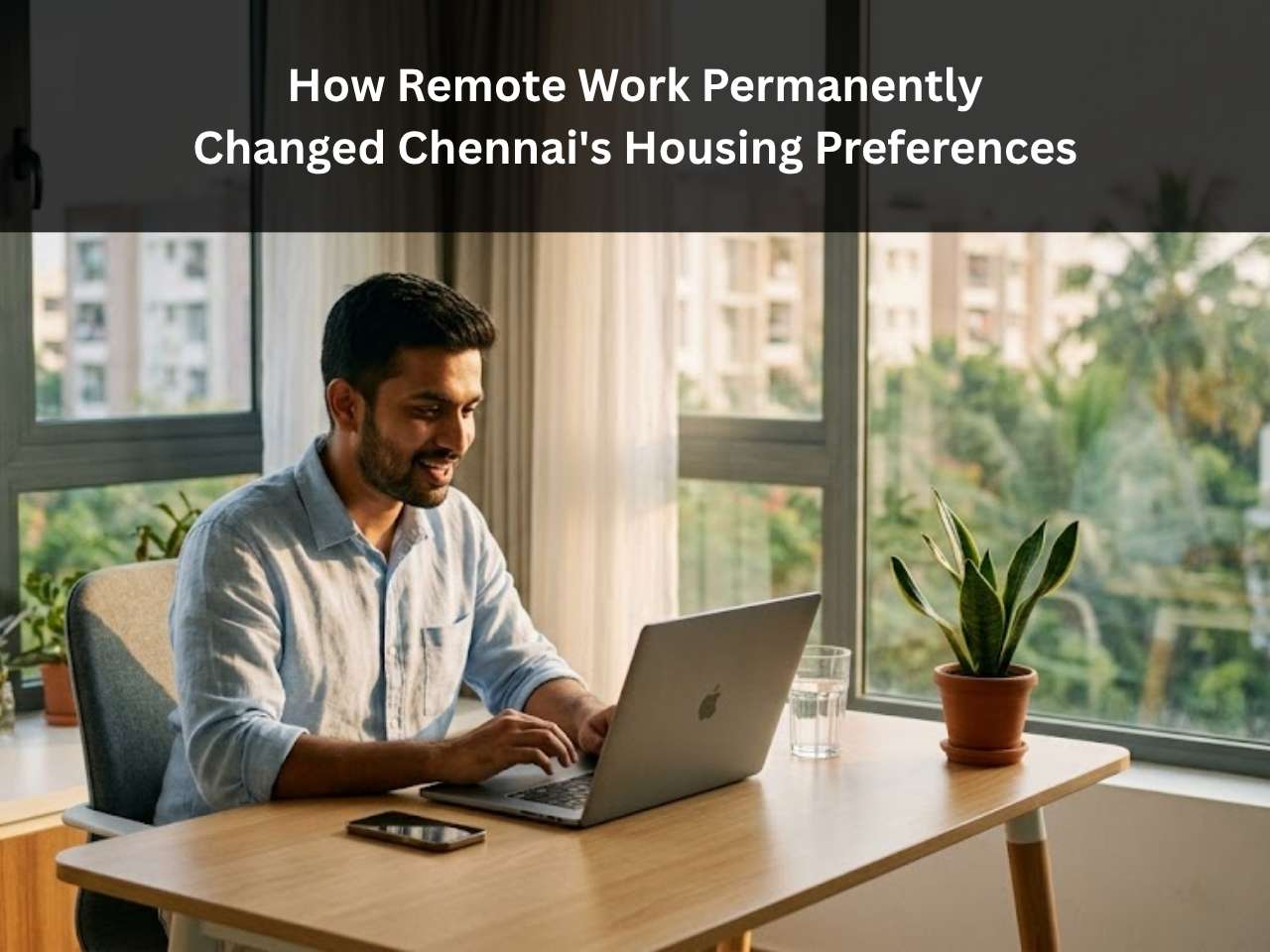
In 2020, working from home felt temporary. A laptop on the dining table, back-to-back video calls, and the constant hope that things would "get back to normal." But somewhere along the way, normal changed. Chennai's IT workforce, one of the largest in the country, started spending more time at home than anywhere else. And that changed everything about what they wanted from a home.
Now, in May 2026, Prime Minister Modi has reiterated his call for India to embrace remote work, this time in response to the global energy crisis triggered by West Asia tensions. India's oil import bill has surged as crude prices push past USD 126 per barrel, and conservation has become a national priority. Industry body NASSCOM has confirmed that major IT firms are already enabling hybrid and remote work as a responsible measure.
|
|
For Chennai's homebuyers, this is not a new conversation. It's confirmation of something the market has already been telling us for five years. The way people choose homes has permanently shifted and the locations, layouts, and lifestyles they're choosing reflect that shift clearly.
How remote work changed home buying priorities in Chennai
Before 2020, the logic of home-buying in Chennai was simple: the closer to a tech park, the better. OMR dominated demand. Sholinganallur, Perungudi, and Thoraipakkam commanded a premium purely because of their proximity to IT corridors. Everything else, space, greenery, community, came second.
Remote work broke that logic. When your office is in your home, the 10-minute commute stops being your top priority. Instead, buyers started asking more meaningful questions. Is there enough space for a dedicated workspace? Is the neighbourhood pleasant enough to spend all day in? Are the amenities good enough to replace what the office used to offer?
The result has been a steady, decisive move towards larger homes in well-connected suburban corridors and away from cramped apartments in congested IT hubs. To know more about how Chennai families are arriving at this decision today, read our breakdown of how Chennai families make their final home buying decision.
What WFH-ready homes in Chennai look like in 2025–26
The checklist has changed. Here's what Chennai's WFH generation consistently prioritises when buying a home today:
-
A dedicated study or work room: no longer optional for families with working professionals
-
Larger 3BHK layouts that allow flexibility: a guest room that doubles as a workspace, for instance
-
Community amenities like co-working lounges, gyms, and open spaces within the gated community
-
Natural light, ventilation, and green surroundings: factors that directly affect daily wellbeing
-
Good road and metro connectivity for the 2–3 days a week that hybrid work still requires office visits
Demand for compact 1BHK apartments has declined sharply across the city. In their place, 3BHK and 4BHK homes with flexible, convertible layouts are leading sales. Buyers are willing to stretch their budgets for projects that genuinely support a work-from-home lifestyle, not just list it as a marketing feature.
Why Porur is Chennai's fastest-growing residential destination
The most interesting outcome of the WFH era has been the rise of West Chennai as a serious residential destination. Areas like Porur, Poonamallee, and Ambattur, historically associated with industry rather than residential living, have seen consistent growth in both sales and appreciation.
The reason is straightforward. These areas offer something that OMR and the city centre increasingly cannot: space, affordability, and strong connectivity, all in one place. For a professional on a hybrid schedule who commutes two or three times a week, West Chennai removes the need to pay a premium for proximity they don't need every day.
For IT professionals working hybrid schedules from offices in Guindy, Ambattur, or the city centre, Porur is genuinely practical. For those working fully remotely, it offers a quality of life that OMR simply cannot match at comparable price points.
West Chennai's infrastructure sweet spot:
Porur sits at the convergence of Mount-Poonamallee Road, GST Road, the Outer Ring Road, and the Chennai–Bangalore Expressway (NH48). Metro Corridor 4, the Poonamallee to Porur stretch, is in its final stages, adding rail connectivity to an already well-served location. End-users, not investors, dominate the buyer profile here, which points to long-term stability rather than speculative demand.
Is work from home here to stay in India?
The data, the policy signals, and the market behaviour all point in the same direction: this is permanent.
Remote and hybrid work is no longer a pandemic concession, it is now part of India's official economic strategy. The Prime Minister's 2026 appeal, NASSCOM's endorsement, and the structural adjustments major IT firms are making to their workplace policies all reinforce the same message. The flexibility that WFH offers is now considered a feature, not a workaround.
For homebuyers, this matters. A home designed for hybrid life, with the right space, the right connectivity, and the right community, is not just a comfortable place to live. It is an asset whose relevance and value will only grow.
Find your ideal WFH home in Porur, Chennai
At Nutech, our project in Porur was designed for exactly this generation of homebuyers. We understood early that the home was no longer a place you returned to at the end of the day, it was a place you lived your entire life from. That understanding shaped every decision, from community amenities and lifestyle infrastructure to layout flexibility, workspace integration, and location.
If you are considering buying a home in Chennai, one that works as well for a focused work morning as it does for a relaxed weekend evening, Porur deserves a serious look.





 Whatsapp
 Call
Call