

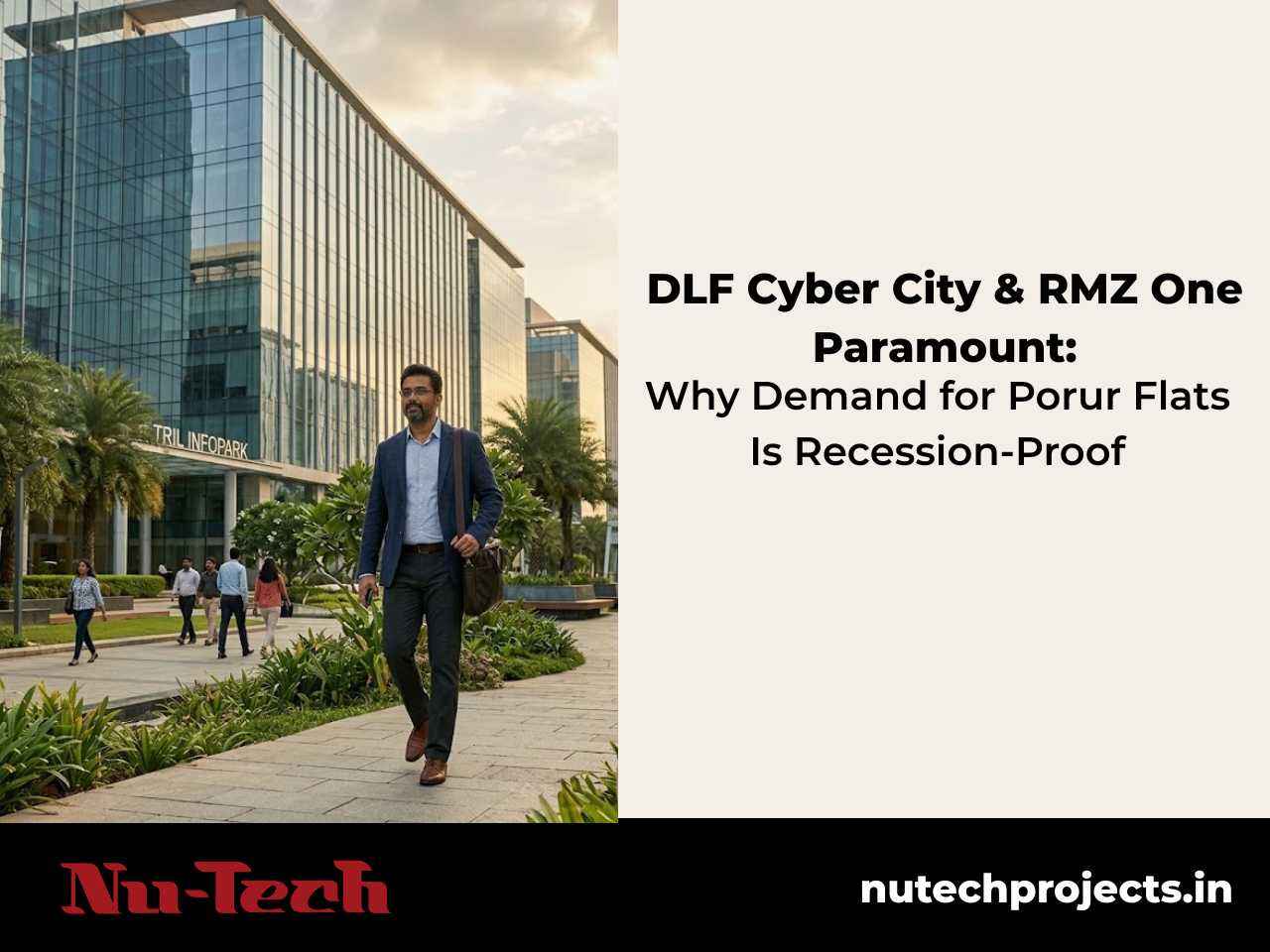
DLF Cyber City & RMZ One Paramount: Why Demand for Porur Flats Is Recession-Proof
Posted on :
Most real estate markets are driven by sentiment. Porur is driven by something harder to shake, employment. And right now, two commercial campuses are doing more to anchor demand for flats in Porur than any number of developer launches or infrastructure announcements ever could.
This is the story of why that matters, and what it means if you're looking to buy here.
The Two Anchors You Need to Know
DLF Cyber City Chennai sits off Mount Poonamallee High Road in Manapakkam, about two minutes from the Porur junction. It's not a project under construction or a campus that just opened. It's over 3 million square feet of occupied, Grade A office space, leased to large IT and BFSI firms on long-term commitments.
RMZ One Paramount anchors the same corridor. RMZ Corp has built its reputation on attracting multinational tenants to premium commercial assets, and One Paramount fits that pattern exactly.
Two campuses. Two different developer pedigrees. Two distinct tenant bases. That combination is what transforms this belt from a location with one large employer, which carries risk, into a genuine employment hub, which doesn't.
Why "Hub" Changes Everything for Buyers
When a micro-market depends on a single employer, it's only as stable as that employer's growth plans. If they downsize, consolidate, or relocate, residential demand softens almost immediately.
A corridor with multiple large occupiers from different sectors is a different animal entirely. The demand it generates is diversified, it doesn't hinge on any one company's fortunes. That's a meaningful distinction when you're buying a home you plan to hold for 10 to 15 years.
It's also why the conversation around why homebuyers are choosing Porur has shifted from lifestyle factors to fundamentals. Greenery and commute times are nice. Anchor employers are what actually protect your investment.
The Buyer Profile Is Unusually Well-Matched
The workforce across these two campuses spans the full career spectrum, from freshers joining their first IT role to senior managers and team leads. That's not a weakness in the demand story. It's actually what makes it broader and more resilient.
Entry-level and mid-career professionals in this corridor are typically in the market to rent first, then buy within three to five years. Senior hires and dual-income households are active buyers today. Together, they create a layered demand cycle, renters becoming buyers, buyers upgrading, and new joiners filling the rental gap behind them.
The ₹70 lakh to ₹1.5 crore segment where most of Porur's residential supply sits captures the buying end of that pipeline well. It's also why flats in Porur still compare favourably against OMR on price-to-income ratios. When you run the home loan EMI numbers carefully, the gap is hard to ignore. OMR has had two decades to price in its office belt status. Porur is still in the earlier innings of that repricing.
What "Recession-Proof" Actually Means Here
Recession-proof doesn't mean the market is immune to price corrections. It means there's always a base of genuine buyers, regardless of what the broader economy is doing. And that base exists only when people need to live somewhere, not just want to.
Porur has that. During the post-pandemic correction that softened absorption across several Chennai markets between 2022 and 2024, this corridor held. Because the professionals filling DLF Cyber City and RMZ One Paramount still needed homes near where they worked. That need doesn't pause for a rate hike or a slowdown quarter.
Compare that with purely aspirational locations that rode sentiment in a bull run and quietly faded when buyer confidence dipped. Porur didn't fade, because the employment anchor kept generating real, non-discretionary demand.
That's the difference. And it's the only kind of stability worth paying attention to when you're making a 15-year financial decision.
Infrastructure Is the Upside, Not the Premise
A lot of Porur coverage leads with metro connectivity and road improvements. Those things matter, but they're being reported in the wrong order.
The Vadapalani–Poonamallee Metro expansion and the ongoing infrastructure upgrades across the corridor are significant precisely because the employment base is already here. Infrastructure arriving into a market with existing demand accelerates appreciation. Infrastructure arriving into a market trying to create demand is a gamble.
Porur is the former. That's a meaningful difference.
Should You Buy Now or Wait?
If you're currently weighing rent versus buy in this corridor, monthly numbers might make renting look more comfortable. But that comparison misses what's building underneath:
-
Commercial occupancy at both campuses is growing, not plateauing
-
The metro timeline is firming up
-
More professionals are choosing to live near work rather than commute from central Chennai
-
Prices haven't yet fully reflected any of this
The window where Porur offers genuine value relative to what it's becoming is real, but it isn't permanent.
If you're doing your homework on this area, the Flats in Porur — The Complete 2026 Buyer's Guide covers everything you need before you decide.
Previous page: The 'West Chennai IT Spine': Why Porur is OMR's Strongest Competitor
Next page: Porur vs. Valasaravakkam vs. Virugambakkam: Which Locality Holds Its Value Better?

 Whatsapp
 Call
Call