

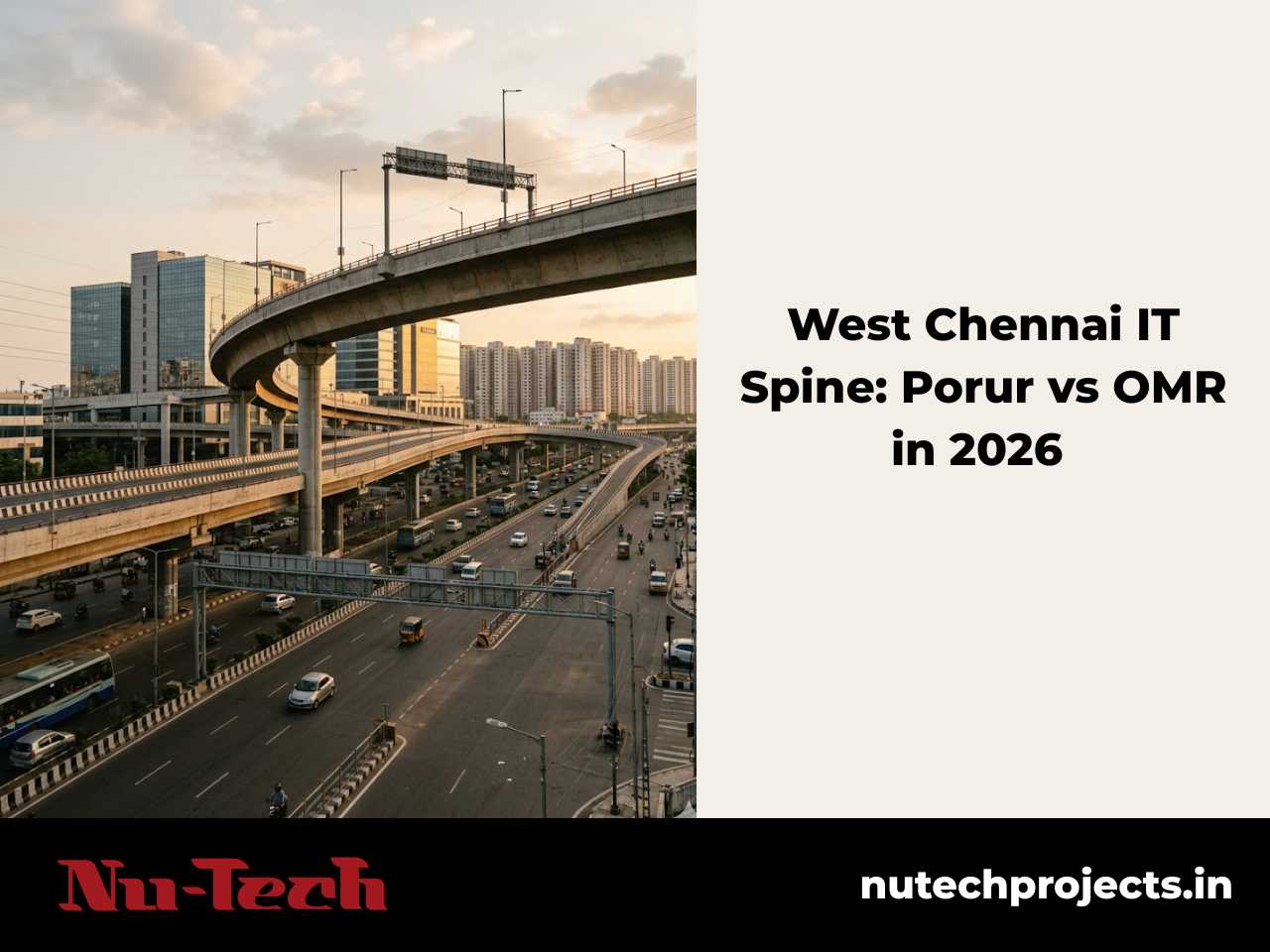
The 'West Chennai IT Spine': Why Porur is OMR's Strongest Competitor
Posted on :
Porur is no longer just a name on a Chennai road sign. Over the last five years, it has quietly become the most connected, most commercially active address in West Chennai. If you are comparing flats in Chennai and OMR is the only corridor on your list, this article will give you a factual reason to start looking at flats in Porur.
What Makes a Neighbourhood an IT Corridor
Two things drive an IT corridor: large commercial employers and the residential demand those employers generate. OMR built its reputation on exactly this combination. TIDEL Park anchored the south, tech companies followed, and apartment complexes filled the gaps.
Porur is replicating that formula. The difference is that it is doing it with better road access, an existing healthcare and education ecosystem, and price points that OMR could only offer a decade ago.
The Two Commercial Anchors Driving Porur's Growth
DLF Cyber City, Manapakkam sits four kilometres from Porur Junction. It is already operational and houses multinationals across IT, consulting and financial services. The professionals working there need housing within a 20-minute commute. Porur is the most logical answer.
RMZ One Paramount is the larger story. This Grade-A commercial development, positioned along the Mount-Poonamallee Road belt, is projected to house upwards of 40,000 working professionals at full capacity. When that many employees need to rent or buy, residential demand in the surrounding area does not inch up. It jumps.
These two projects are not future promises. They are active or near-complete developments that are already influencing rental rates and property enquiries in the Porur belt.
Porur's Road Network Does What OMR Cannot
OMR is a linear corridor. Traffic moves in one direction during peak hours and the options for rerouting are limited. Residents heading into the city during morning rush hour know the frustration well.
Porur sits at the convergence of four major arteries:
-
The Chennai Bypass (NH 48)
-
Mount-Poonamallee Road
-
Arcot Road
-
The Chennai Outer Ring Road
This means a resident living near Porur Junction can reach Guindy in 20 minutes, Sriperumbudur in 25 minutes, Ambattur in 30 minutes and the city centre in 35 minutes under normal traffic conditions. No single corridor in OMR offers that spread of destinations.
For professionals working across multiple office locations or couples working in different parts of the city, that multi-directional access is a practical advantage that no amount of apartment amenities can replace. For a broader look at how road and metro projects are reshaping this entire corridor, read How Infrastructure Development Is Transforming Porur.
The Metro Factor: A 2026 Update
The Porur-Poonamallee Metro stretch is part of Chennai Metro Phase 2. Stations serving the Porur belt are in advanced stages of construction as of early 2026. Once operational, this line will connect Porur directly to the broader Chennai Metro network, reducing dependence on personal vehicles for daily commutes.
Property markets in Chennai have historically shown a 12 to 18 per cent price premium for apartments within 1 kilometre of an operational metro station. Buyers purchasing in Porur before the line goes live are entering before that premium is fully priced in.
Price Per Square Foot: The OMR Comparison
Current market data puts average flat prices in Porur's comparable micro-markets, Mugalivakkam, Madanandapuram and Gerugambakkam, between Rs 7,800 and Rs 9,200 per square foot for new projects from established builders. Established OMR micro-markets like Sholinganallur and Perungudi, by comparison, are ranging between Rs 9,500 and Rs 11,200 per square foot.
That gap represents two things. For end-users, it means more home for the same budget. For investors, it means there is still room for appreciation before Porur reaches the price maturity that parts of OMR already have. If you are weighing whether it makes more financial sense to rent in this corridor first or commit to buying now, the numbers are broken down clearly in Renting vs Buying in Porur: Real Numbers, Lifestyle Impact & Smart Decisions.
What Porur Has That OMR Built Later
One of the consistent criticisms of early OMR development was the absence of day-to-day infrastructure. Schools, hospitals and neighbourhood retail were built reactively, years after the residential boom.
Porur did not have that problem because it was not built around a single industry. The Sri Ramachandra Institute of Higher Education and Research is already operational and draws patients, staff and students from across Tamil Nadu. Multiple CBSE and ICSE schools operate within 3 kilometres of Porur Junction. The retail expansion along Mount-Poonamallee Road means supermarkets, restaurants and clinics are already in place.
A buyer moving to Porur in 2026 does not need to wait for the neighbourhood to catch up. The infrastructure is already there.
Who Should be Looking at Porur Right Now
Porur is a strong fit for four types of buyers:
-
IT professionals working in Manapakkam, Guindy or the western industrial belt who want a shorter commute without paying OMR prices.
-
Families who prioritise schools and hospitals within close reach and are buying for long-term residence.
-
Investors looking for a corridor where rental demand is growing but capital values have not yet peaked.
-
Couples where both partners commute to different parts of the city and need a central location that works for both.
If you are considering flats in Porur, the chances are high that this corridor already fits your brief. If you fall into any of these categories, the available apartment units in Porur listed by Nutech Projects are a practical starting point for understanding what your budget can get you in this corridor today.
The Straightforward Case for Porur
OMR is a mature market. The heavy appreciation cycle that made early buyers wealthy has already run its course in the core stretches. Porur is at a different point in that cycle. Commercial anchors are in place. Infrastructure is operational. Metro connectivity is incoming. Prices still have room to move.
The buyers who got into OMR between 2008 and 2013 made the most of that corridor. The equivalent window in Porur is open right now.
For a full breakdown of what to check before buying, how to compare builders and what the legal process looks like, read the Flats in Porur — The Complete 2026 Buyer's Guide.
Next page: DLF Cyber City & RMZ One Paramount: Why Demand for Porur Flats Is Recession-Proof

 Whatsapp
 Call
Call