

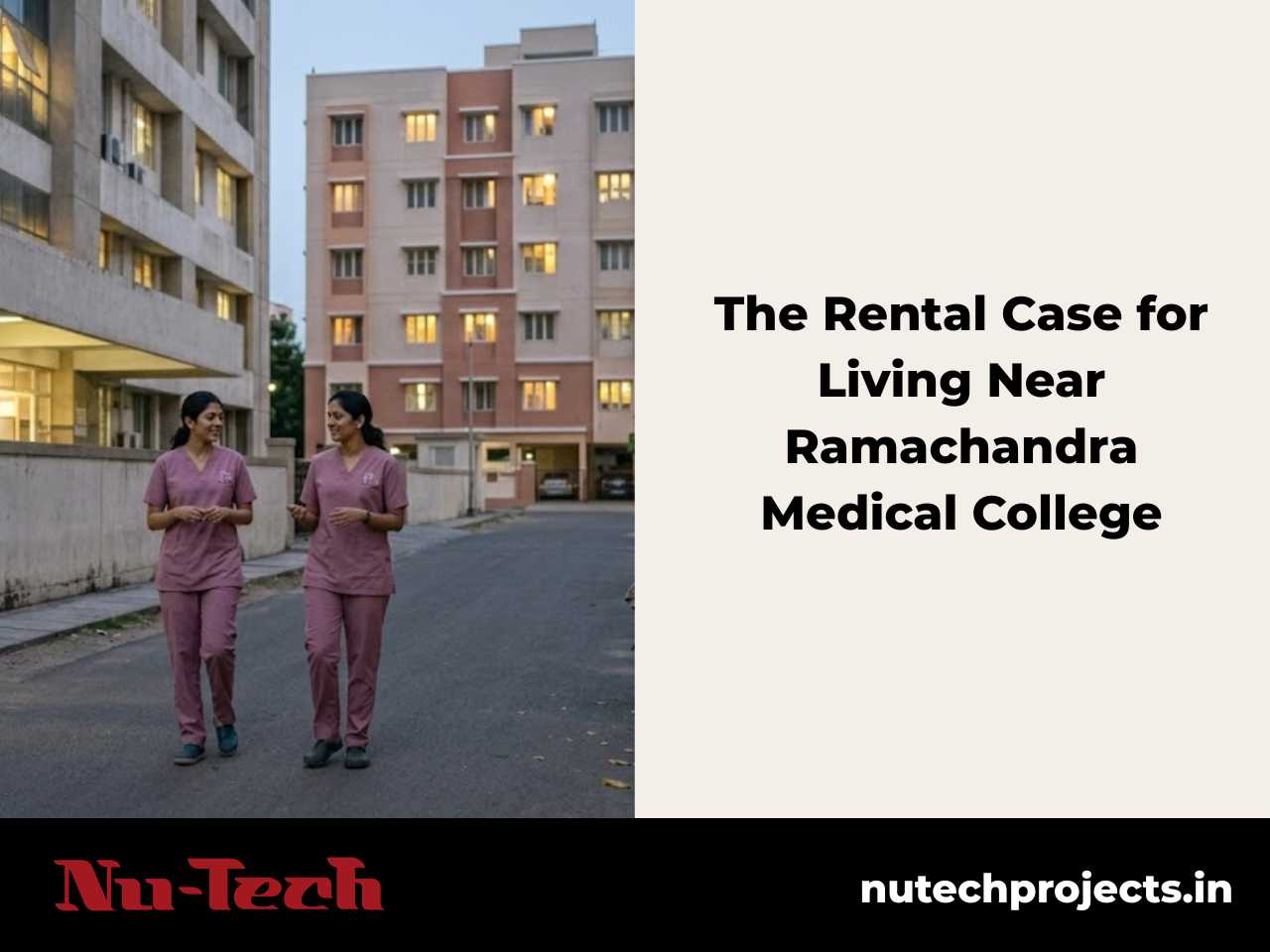
Living Near Ramachandra Medical College: High Rental Yields from Healthcare Professionals
Posted on :
Most buyers who come to Porur are end-users. They want a good home in a well-connected part of Chennai at a price that does not require a second mortgage. But a quieter group of buyers is also paying close attention here: investors who have run the numbers and noticed something. Rental demand in Porur is not driven by a single industry or a single type of tenant. It comes from multiple directions at once. That diversity is not a small thing. It is exactly what makes rental income here more stable than it looks on paper.
The Demand Stack: Who Actually Rents in Porur
Before you can assess rental yield, you need to understand who is doing the renting. In Porur, that answer is more varied than most people expect.
Healthcare workers from Sri Ramachandra Institute form one significant layer. But they are not alone. Families relocating for access to established schools in the area, including institutions along the Nolambur and Mogappair stretch, rent here for years at a stretch. Professionals working in the tech and light industrial belt running through the Porur-Poonamallee corridor need a western Chennai address without the price tag of Anna Nagar or Nungambakkam. And increasingly, working couples who want proximity to both the city's interior and its bypass routes are landing in Porur because it sits at a useful junction.
Each of these groups rents for different reasons. That is precisely the point. When one segment softens, the others do not necessarily follow. That kind of structural diversity in tenant demand is something most single-anchor locations in Chennai simply do not have. If you want to understand why homebuyers and investors are choosing Porur over comparable western suburbs, this layered demand is a large part of the answer.
Why Ramachandra Anchors the Rental Market More Than Anything Else
Within that demand stack, Sri Ramachandra Institute of Higher Education and Research occupies a different category. It is not just large. It is permanent, self-replenishing, and operationally continuous in a way that no tech campus or corporate office can match.
The institution runs multiple faculties on the same campus:
-
A full teaching hospital with round-the-clock operations
-
A medical college producing postgraduate residents on two to three year cycles
-
A dental school, pharmacy faculty, and allied health sciences programmes
Each of these generates a distinct wave of people who need housing nearby. Postgraduate residents, nursing staff on rotating shifts, visiting and permanent faculty, paramedical workers, and administrative professionals all form part of the tenant pool. A new cohort arrives every academic year. Many who finish their programmes stay on, either at the same hospital or at the clinics and diagnostic centres that have grown up around it.
The result is a captive rental market with three properties that matter to any investor:
-
Demand does not slow down in a downturn the way IT-driven rentals can
-
The campus is not relocating, and the institution is not restructuring its headcount
-
Occupancy in the surrounding radius replenishes itself on a predictable academic and contractual calendar
For a flat owner within 2 to 4 kilometres, that translates into consistent occupancy with tenants who have a genuine, non-negotiable reason to be close.
What the Rental Numbers Actually Look Like
Rental yields in Porur currently sit between 3.5 and 4.5 percent annually for well-maintained 2 BHK units, depending on building quality, floor level, and distance from key institutions. For properties on and around the Ramachandra corridor, covering areas like Alapakkam, Nolambur Road, and Kovur Road, 2 BHK flats in the 60 to 75 lakh range are typically commanding monthly rents between 18,000 and 24,000 rupees.
Several factors push rents toward the higher end of that band:
-
Semi-furnished or furnished units that reduce setup effort for tenants arriving from other cities
-
Reliable power backup and functional lifts, which matter significantly to professionals working night shifts
-
Clean, well-maintained common areas, a baseline expectation for healthcare workers
-
Proximity to the Porur signal junction or the 100 Feet Road, which connects to multiple parts of the city
These yields are not exceptional by national benchmarks. But they hold. And in rental income, an unbroken 3.8 percent over five years beats a volatile 5 percent with two extended vacancy gaps. Before committing to a unit, it is worth mapping your home loan EMI planning against realistic rent expectations rather than optimistic ones.
Infrastructure Making the Case Stronger
Porur's investment case has always rested partly on what is coming, not just what is already here. The difference in 2026 is that several of those future bets are now close enough to price in seriously.
The Vadapalani to Poonamallee Metro corridor will change commute patterns for the entire western suburbs. For a tenant who works near Ramachandra but whose spouse commutes to T. Nagar or Vadapalani, metro access is not a minor convenience. It is the factor that makes Porur viable rather than merely acceptable. That widens the tenant catchment considerably beyond the immediate institutional cluster.
The road network has also matured. The Chennai Bypass, the 100 Feet Road running toward Nolambur and Mogappair, and improved link roads toward Poonamallee have made the area navigable in a way it was not five years ago. The broader infrastructure transformation reshaping Porur is not speculative anymore. It is visible on the ground, and tenants are factoring it into their choices.
What to Look for When Buying for This Market
A flat in Porur will not automatically attract stable tenants. Location is the starting point, but building quality, unit configuration, and proximity to the key demand anchors in the area determine whether your unit stays occupied or sits vacant between tenants.
Distance from Ramachandra campus is the first filter. Under 3 kilometres is the zone where demand is strongest and vacancy is lowest. Between 3 and 5 kilometres, you are still within range but competing more directly with units elsewhere. Beyond 5 kilometres, the institutional pull weakens and you are relying more on the general Porur demand story.
Unit configuration matters too:
-
2 BHK is the most liquid size for this tenant demographic. It works for a couple, a resident doctor with a family member, or two professionals sharing
-
1 BHK sees faster churn as tenants upgrade or leave the area after short programmes
-
3 BHK narrows your pool considerably unless the building and location are genuinely premium
Builder track record is underrated as a factor. A well-managed building retains good tenants. A poorly maintained one loses them quickly and gets stuck with whoever is left. Buying from a reputed builder is not just about construction quality. It is about whether the building will still be well-run three years after possession, when your tenant is deciding whether to renew or leave.
The Honest Case for Buying Here in 2026
Buying flats in Porur near Ramachandra is not a high-drama investment story. It will not double in two years. Nobody credible is promising that, and you should be cautious of anyone who does.
What this corridor offers is something more useful for most investors: a rental income stream that is structurally supported rather than cyclically dependent. The institution is not moving. The metro is coming. The schools and hospitals that make this a genuine residential neighbourhood rather than a speculative land bank are already here and functioning. The tenant types, from healthcare workers to families to working professionals, are diverse enough that a slowdown in one segment does not collapse your income.
There is also a timing argument. Porur is not yet priced as a premium investment destination. The window where you can buy at reasonable values and still capture the appreciation that better connectivity will bring is narrowing but not closed. Buyers who waited for OMR to mature paid significantly more than those who bought early. The parallels with Porur's current position are hard to ignore if you are paying attention.
For everything you need to evaluate a purchase here, from locality comparisons to builder shortlists to pricing benchmarks, the complete resource is the Flats in Porur — The Complete 2026 Buyer's Guide.
Previous page: What AI Predicts for Porur Flat Returns Over the Next 10 Years
Next page: The 'Sri Ramachandra' Effect on Senior-Citizen Demand for Porur Flats

 Whatsapp
 Call
Call