

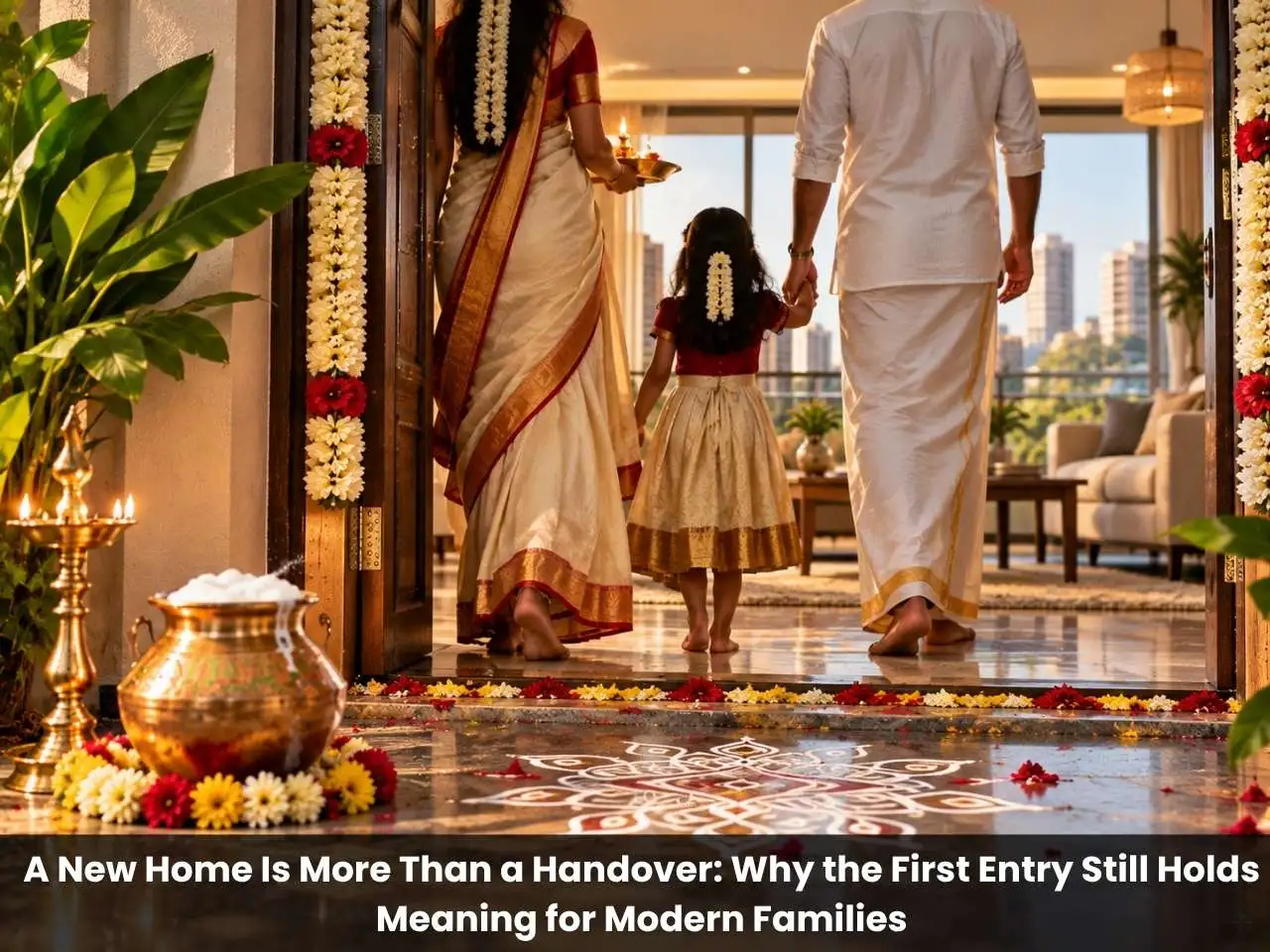
Why Gruhapravesam and Housewarming Still Matter to Modern Homebuyers
Posted on :
Written by : Farvesh Ahamed

The sale deed is registered. The keys have been handed over, the modular kitchen is fitted and the electrician has finished his last round. By every legal measure, the flat belongs to the family. And yet families who follow tradition often wait to move in until a date fixed with a priest for the Gruhapravesam, or housewarming.
The wait makes sense once you separate two events that usually get treated as one. Buying a property is the first. Beginning life in it is the second, and the first entry, whatever name a family gives it, is how that second event gets marked. The ceremony now has to fit into apartments, working weeks and families spread across countries. Its purpose, marking the start of life in a new home, applies to a flat as much as to a house, which is why modern housewarming rituals still carry weight for urban homebuyers.
Getting the keys and moving in are not the same milestone
Handover is a transaction. The buyer pays, the deed is registered at the sub-registrar’s office, the builder issues a possession letter and the keys change hands. Moving in is the day a family cooks and sleeps in the place for the first time.
Most urban homebuyer milestones are paperwork milestones. The loan sanction, the sale agreement, the registration and the handover all happen on documents or at counters. The first entry is the one milestone that happens inside the home itself, with the people who will live there and the people who matter to them. That is a large part of why families are willing to wait for it, and to wait for a particular day.
The calendar often matters earlier, at the sub-registrar’s office. Tamil Nadu’s Registration Department has added capacity on days people consider auspicious. Ahead of Avani Avittam on 27 August 2026, the Inspector General of Registration raised daily token limits from 100 to 150 at single sub-registrar offices for that day. For many buyers, the same calendar decides when the deed is registered and when the family moves in, so the timing belongs on any checklist of what to verify and arrange before buying a home
in Chennai.
What Gruhapravesam means in its own terms
Griha pravesha is a Sanskrit term for a ceremonial entry into a house, from griha (house) and pravesha (entrance). Tamil families usually call it Graha Pravesam or Puthumanai Pugu Vizha, and spellings such as Gruhapravesam and Griha Pravesh are common elsewhere. Within the Hindu tradition, the ceremony is performed to purify the new house, seek blessings and invite prosperity before the family starts living there. The date and hour, known as the muhurtham, are typically fixed after consulting a priest or astrologer.
Priests and puja guides commonly describe three forms of the ceremony. They line up with modern homeownership more closely than the old names suggest.
| Form | When the tradition prescribes it | The situation it resembles today |
| Apurva | First entry into a newly built home | Moving into a newly completed flat or villa |
| Sapurva (also written Sampurva) | Re-entering a home after a long absence, such as a return from abroad | An NRI family moving back into a home it lived in before going abroad |
| Dvandva | Entering after reconstruction or major renovation | Moving back into the family’s own flat after a major renovation or repair |
Practices vary between regions, communities and families. Common elements include a Vastu Shanti rite and, in many South Indian homes, boiling milk on the new stove until it overflows. That custom shares its logic with the Tamil harvest festival: the word Pongal comes from pongu, meaning “to boil over,” and in both settings participants read the overflow as a sign of abundance. Some families also keep the older custom of leading a cow into the house before anyone else enters. These are beliefs held within the tradition. Families observe them to very different degrees.
What city life asks
of the ceremony
Three things shape the ceremony in a city like Chennai. The first is space. An independent house gives a family its own threshold, its own compound and room for a large gathering. A flat on the ninth floor shares a lift, a corridor and a lobby with dozens of other households. Under the Tamil Nadu Apartment Ownership Act, 2022, in force since March 2024, each owner holds an undivided share of the common areas in proportion to the flat’s carpet area. The lobby and lift a housewarming crowd passes through belong to every household in the building, while the homam, the ritual fire that is part of many Griha Pravesh pujas, has to be held inside the flat itself. The housewarming is one small part of a longer story about how shared space in Chennai moved from the thinnai to the clubhouse, and it now sits on the private side of that line.
Time is the second. When both partners work, the muhurtham has to fit around leave and office hours as well as the calendar, and a smaller household has fewer people to prepare the home and receive guests. For households that now work from home part of the week, the first entry also opens an office, which gives them one more reason to want a clear start.
Distance is the third. For a family that bought in Chennai from abroad, the date has to match when they can travel, and puja service providers now advertise online griha pravesh arrangements aimed at NRIs. An owner returning after years away to a home they lived in before may think of the occasion as Sapurva, the tradition’s name for re-entering a home after a long absence.
Why the first entry still matters to families
The ceremony survives because it does a job the paperwork cannot. A registered deed proves ownership to the state. It does not tell parents, siblings, in-laws or old neighbours that the family has arrived somewhere new.
Inviting them in does.
In many Chennai households, buying a home is a shared decision. Elder approval is often one of the stages a purchase passes through, as this look at how Chennai families reach a home-buying decision describes. The housewarming is where the result is shown back to the same people who weighed in. Seen that way, the gathering closes a loop that began months or years earlier.
The first meal matters for a similar reason. Boiling milk on a new stove is, in the plainest sense, the first time the kitchen is used. After that morning, the flat stops being a finished product and starts being a place where routines happen. Transforming a house into a home takes years of ordinary days, and families want a starting point they can remember. A named day with people present gives them one.
What a property listing cannot show
A property is described by things that can be measured: location, carpet area, floor plan, price and amenities. Buyers compare these carefully, and they should. None of them says how a family will live in the space.
The first entry is often when those unmeasured things surface. Where does the pooja shelf go? Can the living room hold thirty relatives for an hour? Is the stove where the family wants it? A family planning a traditional ceremony can settle these questions before buying, alongside the broader questions homebuyers ask about how well a flat is designed for everyday living.
The ceremony may be a short morning puja or a lunch with a few close friends. It may include a homam or only a lit lamp and a pot of milk. A developer can hand over a well-built flat, but the routines and memories that make it a home come afterwards, starting on a day the family chooses and with the people they choose. Whatever form the first entry takes, it rests on the same idea. Ownership ends at the handover desk and home begins at the door.
Frequently
asked questions
What is the difference between Gruhapravesam and
a housewarming?
Gruhapravesam, also written Griha Pravesh or Graha Pravesam, is the Hindu ceremony of formally entering a new home, usually on a muhurtham fixed by a priest, with rites such as Vastu Shanti. A housewarming is the broader social occasion of inviting people to a new home. In India the two terms are often used for the same occasion.
Can a Gruhapravesam be held in an apartment?
Yes. The ceremony is not limited to independent houses, and apartment developers publish Gruhapravesam guides for their buyers. In a flat the limits are practical: room for the homam, how many guests the lift and living room can take and the apartment association’s rules on common areas, which every owner in the building shares.
Is a Gruhapravesam required before moving into a new flat?
No law requires it. It is a cultural and religious choice, and families decide whether to hold one and how elaborate it should be. The legal steps of buying a home, such as registering the sale deed and taking possession, are separate
from the ceremony.
What are the three types
of Gruhapravesam?
Priests and puja guides commonly describe three forms. Apurva is the first entry into a newly built home. Sapurva is re-entering a home after a long absence, such as a stay abroad. Dvandva is entering after reconstruction or major renovation.
Why do some families boil milk until it overflows in a new home?
In many South Indian homes, milk is boiled on the new stove until it spills over during the first entry. Within the tradition, the overflow is read as a sign of abundance, similar to the boiling over of rice and milk at Pongal. It is also the first use of the new kitchen.





 Whatsapp
 Call
Call