Porur, Then and Now: How a Lakeside Village Became West Chennai's Busiest Address
Posted on :
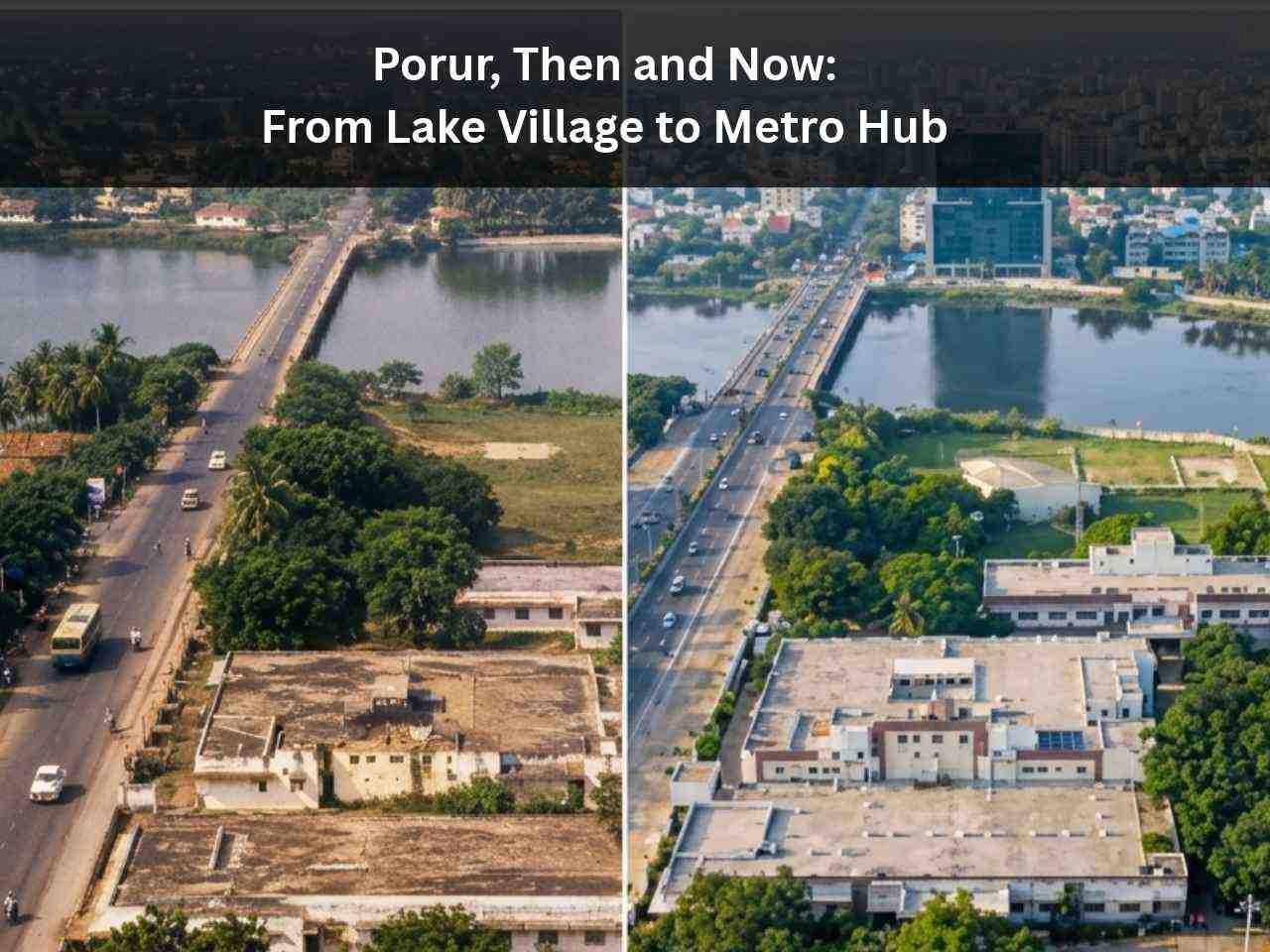
Stand at Porur junction today and you'll see three layers of the city stacked on top of each other. There's the old road at the bottom, the MGR flyover above it, and since October 2026, a metro line gliding past.
A few decades ago, there was only the road, a lake and a temple.
Today, Porur is one of the most complete neighbourhoods in Chennai to live in. A major hospital is down the road, schools and supermarkets are close by, offices are a short ride away, and the old temple and lake still give the area its character. Few parts of the city offer all of that in one place.
This is the story of how Porur got from there to here, and why so many families now choose to call it home.
Older Than Most of Chennai
Porur's roots go back over a thousand years. During the Chola period, it was the headquarters of an administrative division called Perur Nadu.
The Ramanatheswarar Temple near the junction is the oldest reminder of that past. Its origins trace back to the Cholas, and it is one of the nine Navagraha temples of the Tondai Mandalam region, revered as the Guru sthalam. Local belief holds that Lord Rama worshipped Shiva here as his Guru on the way to Lanka, which is why some still call it Uthara Rameswaram.
Every year, Guru Peyarchi still draws large crowds of devotees here, a tradition far older than any building around it.
The 1960s and 70s: A Quiet Village on the Edge of Madras
In 1961, Porur was a little-known village in the Saidapet taluk of what was then Chengalpattu district. Madras city felt far away.
Life revolved around Porur Lake, spread over about 200 acres and still one of the city's important drinking water sources. Long before apartment towers arrived, the view around it was mostly open land.
On 1 October 1977, the village panchayat was upgraded to a town panchayat. It was a small administrative change, but it was the first sign that Porur was growing.
1985: The Hospital That Put Porur on the Map
On 11 September 1985, Sri Ramachandra Medical College started in a modest two-storey building in Valasaravakkam, with its first outpatient clinic in a makeshift shed. Over the following years, it grew into a large medical campus near Porur, and it became a deemed university in 1994.
That changed everything. Doctors, nurses, students and patients' families needed homes, shops and transport nearby. For many people across Tamil Nadu, "Porur" simply meant "Ramachandra hospital".
2007: The IT Wave Reaches the West
In the 2000s, most of Chennai's IT growth was happening along OMR in the south. Then, in April 2007, DLF's IT SEZ opened on Mount Poonamallee Road in Manapakkam, just minutes from Porur.
Suddenly, thousands of young professionals were working on this side of the city. Many didn't want a two-hour commute to OMR, and Porur, Iyyappanthangal and Valasaravakkam became their natural choice for a home.
Also read: Porur real estate market updates
2011 to 2017: From Suburb to City
In 2011, Porur became part of the Chennai Corporation. By then, its population had crossed 30,000, and the junction where Arcot Road meets Mount Poonamallee Road had become one of the most congested spots in west Chennai.
A flyover was proposed in 2010. Construction dragged on for about seven years, and people who lived through it still remember the dust and the daily jams. When it finally opened in June 2017, named after MGR, the relief was city-wide news.
2026: The Metro Arrives
On 11 October 2026, the Poonamallee Bypass to Vadapalani stretch of Chennai Metro Phase II opened to the public. The 14.6 km elevated line has 11 stations, including Iyyappanthangal, Porur Bypass and Porur Junction, and connects to the existing metro network at Vadapalani.
For Porur, this closes a long chapter. A place that once took a bus and an auto to reach central Chennai is now on the city's rail map.
What Hasn't Changed
For all the concrete and steel, some things in Porur have stayed the same.
The lake still catches the evening light, best seen from the Chennai Bypass. The temple bells still ring at 6 am. The market near the junction is still where families go for fresh vegetables and flowers before a festival. And the hospital, now much bigger, is still the place half of Tamil Nadu knows by name.
Porur grew up without losing its centre, and that may be why so many families who move here end up staying.
What This Means for Homebuyers Today
Buying in Porur used to mean betting on what was coming. Today, most of what was promised is already here: the hospital, the IT parks, the flyover and now the metro.
That changes the question. You're no longer asking whether Porur will grow. You're asking which part of it suits your family best. If you're comparing flats in Porur, it helps to look at how close each option sits to the places that built this area, from SRMC to the IT corridor to the new stations.





 Whatsapp
 Call